
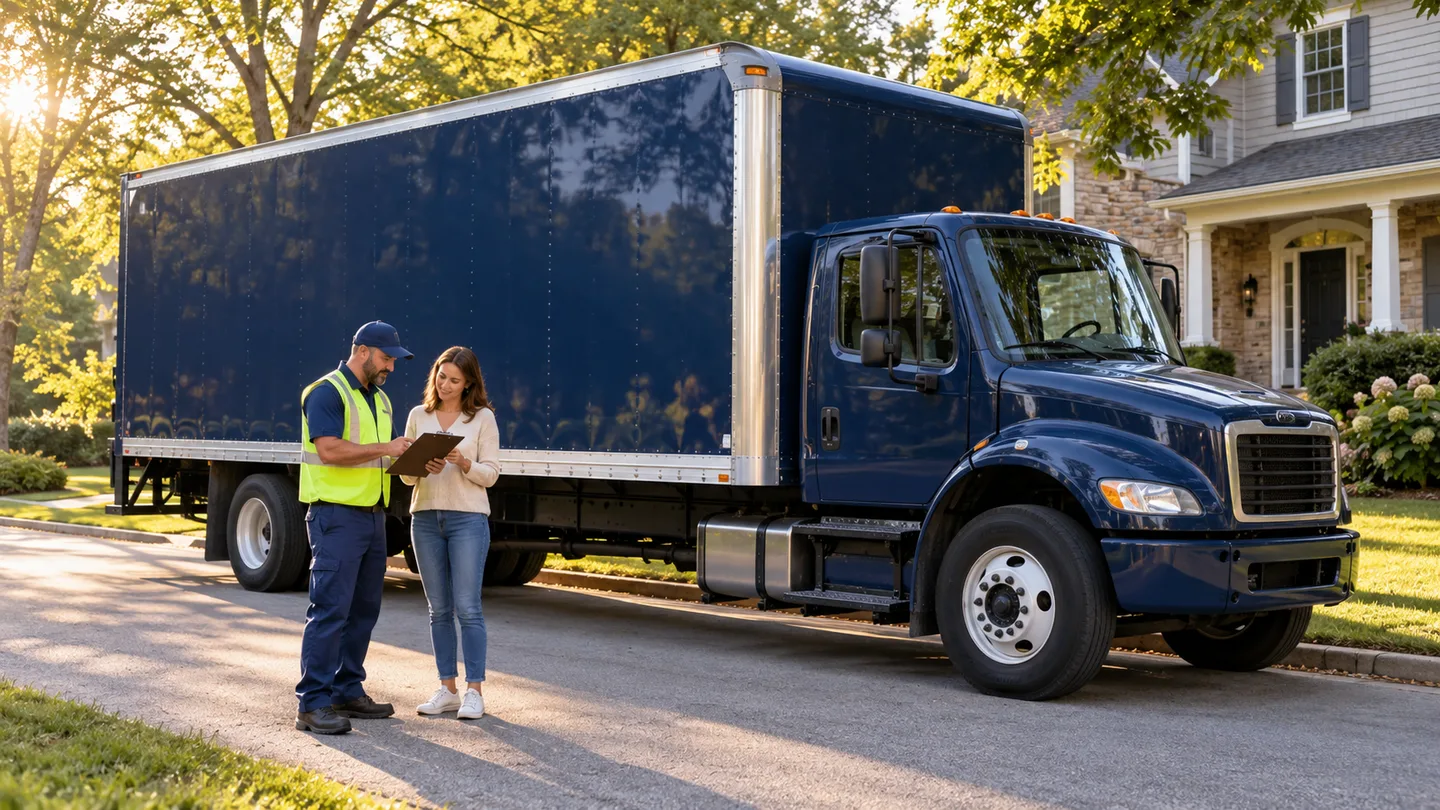
A dedicated truck and a consolidated shipment can carry the same household across state lines, but they organize the trip differently. Dedicated service usually reserves a vehicle or defined capacity for one customer. Consolidation places more than one customer's shipment on a route, separated and identified under the mover's procedures. The difference affects routing, handling, scheduling, documentation, and price. It does not by itself tell you which move will be safer or better. A poorly planned dedicated load can have problems; a carefully documented consolidated load can arrive as agreed.
Ask the company to describe the actual transport method it is quoting, not just use a label. Will the same truck that collects the goods make the line-haul trip? Will goods be transferred at an origin warehouse? Will another customer's shipment share the vehicle? How are shipments separated, numbered, and checked at delivery? Can the carrier substitute vehicles? Is the pickup or delivery date guaranteed, or does the contract specify a spread of possible dates? Record the answers in the estimate and order for service.
United Van Lines' moving FAQ says an average household often does not fill a truck, so two or more shipments may ride on the same vehicle and be sectioned off. FMCSA's service-options guidance also notes that a shipment may sometimes be divided among two vehicles. These are reasons to clarify the physical plan, not reasons to assume that “consolidated” means goods are mixed without identification or that “dedicated” means no later equipment change.
Define what the quote promises

A sales page may use “exclusive,” “direct,” “express,” or “dedicated” loosely. Ask whether the promise covers the whole truck, a sealed container within a larger truck, a reserved amount of space, or only a schedule. If a truck carries just your shipment at pickup but takes other shipments later, it is not the same as exclusive use for the entire trip. If a sealed container travels alongside other customers' containers, the physical boundary is the container, not the tractor. Request the service description in writing, including any conditions under which equipment or crews can change.
For a consolidated move, ask how the carrier labels each item, separates goods, and reconciles the inventory at every transfer. A household-goods van may have sections or partitions; a containerized service may put each customer's goods in distinct units. A shared freight trailer can hold a locked customer section plus non-household commercial cargo. These arrangements are not interchangeable. Their loading responsibilities and claim terms may differ. Ask who loads and secures each section and whether the goods can be accessed during transit.
For dedicated service, ask what happens if the booked truck breaks down, the shipment exceeds estimated capacity, or the destination street cannot take the line-haul vehicle. A carrier may need to transfer goods or use a smaller shuttle even after selling a dedicated line haul. That contingency does not necessarily invalidate the original service, but it changes the handling plan. Identify who authorizes and documents a transfer, whether the customer is notified, and whether an additional charge applies.
Compare schedules using the contract dates
A dedicated vehicle may have fewer planned stops, but its delivery is not automatically guaranteed. A consolidated route may include several pickups and deliveries, but the carrier still has agreed dates or a delivery period. FMCSA's transportation guidance explains reasonable dispatch for covered interstate moves and distinguishes it from guaranteed delivery service. The practical task is to read the dates and service level on the order for service and bill of lading rather than infer a promise from marketing language.
Ask for the earliest and latest expected delivery dates and any conditions that change them. If the household cannot accept delivery before a lease begins, say so before booking. If a child starts school or a job requires equipment on a certain day, ask whether the carrier offers a genuinely guaranteed date and what compensation applies if it misses it. FMCSA's service-options page describes guaranteed service as an agreement with specific dates and predetermined compensation. A verbal statement that a route “usually takes a week” is not the same contract.
Ask how the carrier updates customers during the trip. Does tracking show the shipment's physical location, the truck's last scan, a terminal event, or only a revised delivery estimate? Who can provide a confirmed appointment when the vehicle nears the destination? The route and delivery-spread guide explains how to read those documents. The dedicated-versus-consolidated choice should use that written window alongside any hoped-for transit speed.
Count handling events, not just miles
A shipment can travel a long distance with few touches or a shorter distance with several. Ask the provider to map origin loading, possible warehouse unloading, line-haul loading, destination transfer, and final delivery. A consolidated route may involve extra handling to sequence customers, but some consolidated loads stay on one van. A dedicated truck may still use a warehouse or shuttle. The number of touches is a question to ask about the proposed route, not an invariant property of a service label.
Each handoff creates a record opportunity. The inventory should identify items and their visible condition. The bill of lading and equipment IDs should identify the shipment. If goods are transferred, ask for a transfer record and whether the customer can receive a copy. If a sealed container remains closed while it changes chassis, note that distinction. It is not the same as unloading loose furniture into a second vehicle. A provider that can describe its process precisely gives the household more useful information than one that simply promises “no worries.”
Prioritize vulnerable goods: artwork, glass, instruments, antique furniture, electronics, and unusually heavy pieces. Ask how they will be packed, crated, positioned, and identified. The best method may depend more on that treatment than on whether another family's sofa shares the truck. If specialist handling is needed, get it listed in the estimate and confirm who performs it. A dedicated truck does not make an uncrated glass top safe by itself.
Test the capacity estimate and overflow plan
A dedicated truck still has a finite floor, volume, and weight capacity. Confirm that the estimate includes every intended item and realistic carton count. Ask what happens if the shipment does not fit. FMCSA's service-options guidance discusses a “leave behind” when a shipment is split across vehicles and advises accurate measurements and prioritizing essential items. Ask whether the remainder would travel later, whether its delivery window differs, and how its inventory and vehicle numbers will be recorded.
Consolidated service also depends on accurate size. An unexpectedly large shipment may not fit the reserved route segment and could require a different vehicle or departure. Ask when the space commitment becomes firm, whether the quote is based on weight, volume, or reserved capacity, and how a change is priced. If the household adds a storage unit or a second pickup address, update the estimate before loading day. A low price that assumes half the actual goods is not a meaningful comparison.
Separate minimum size from exclusive use. A small apartment may cost more per item on a dedicated truck because the vehicle travels partly empty. A consolidated route can spread line-haul cost across shipments. Yet route density, season, access, storage, packing, and valuation can change the total. Compare written all-in estimates for the same inventory and services, not slogans about one method always being cheaper.
Read what is included in each price
Build a side-by-side worksheet: packing and materials; pickup labor; origin shuttle or long carry; line haul; storage; destination shuttle; unloading and reassembly; valuation or protection; fuel or service charges; and any accessorial fees. Mark each as included, optional with price, conditional with trigger, or excluded. A dedicated quote may include an assigned crew while a containerized consolidated option leaves loading to the household. Those are different products. Add the cost of local labor and equipment before declaring one a bargain.
Ask whether the final charge can change and why. A binding estimate, nonbinding estimate, and customer-loaded space-based price have different rules. FMCSA's estimate guidance explains the regulated interstate categories, but a self-service container contract may use a separate structure. Have the provider identify the pricing basis in its own document. Do not compare a fixed container rental to a moving van's preliminary weight estimate as though both totals have equal certainty.
Think about delay costs that sit outside the transportation invoice. A wider delivery spread may require temporary essentials, extra lodging, storage, or time away from work. A shorter dedicated schedule may save those costs, but only if the written dates support it. Conversely, a household with flexible arrival timing may value a lower consolidated price more. The relevant comparison is total practical cost under the family's actual deadline, not just the first number on the quote.
Run a realistic household scenario
Imagine a two-bedroom move from Richmond to Chicago with a confirmed apartment handover at the destination on the 12th. The household owns a sectional, two bedroom sets, a desk, a fragile dining tabletop, and about eighty cartons. A dedicated-truck bidder offers pickup on the 5th and says delivery is likely on the 10th, but the written document allows the 9th through the 13th. A consolidated bidder offers pickup on the 4th or 5th and a written delivery spread from the 11th through the 16th. The first option might be faster, but it could arrive before the apartment is available; the second might require several days of essentials kept outside the shipment. The family should compare both written windows with the actual access date, not the sales representative's most optimistic day.
Now change one fact: the destination building permits freight elevators only on weekdays. A delivery spread that includes a weekend does not mean the carrier can use the elevator then. Ask whether the provider can schedule within the approved hours, whether waiting creates storage or redelivery charges, and who secures the reservation. If the line-haul truck cannot reach the building, a shuttle may be required under either method. A dedicated line haul does not erase final-mile access costs. The household needs a quote that names this building constraint.
Change another fact: the tabletop requires a crate and the desk must be disassembled. Ask both bidders who provides those services, whether the work happens at pickup or a warehouse, and how the pieces will be identified. A carrier with a clear crating and inventory plan may be a better fit than a nominally more exclusive truck with an undefined packing scope. This scenario is illustrative, not a statement about a particular mover's prices or transit time. Its purpose is to make each quote answer the same operational questions.
Clarify responsibility at every transfer
Ask for the legal name of the motor carrier that will transport the goods and whether a broker is arranging the service. Check registration and complaint history through FMCSA's official tools for an interstate carrier. A logo on a sales page does not identify every operator. Ask whether agents or subcontractors will handle packing, warehouses, line haul, and final delivery, and who receives a loss or damage claim. This matters under either transport method.
The person at pickup should review the item inventory and condition notations with the crew. If goods are consolidated, verify that the labels and shipment number stay distinct. If a dedicated truck is substituted, record the new vehicle ID. The guide to recording trailer numbers and dispatch contacts provides a practical handoff log for either model. It helps the household ask a specific question when a tracking status or arrival estimate is unclear.
At delivery, compare the goods with the inventory and note visible exceptions before signing a clean receipt. FMCSA's delivery guidance addresses the delivery receipt for covered moves. The same practical principle applies more broadly: know what the signature says and retain a copy. The service label does not determine whether a missing carton can be identified; item-level records do.
Inspect the promise of “exclusive use”
If exclusive use matters, ask the provider to define the promise's start and end. Does it mean no other household goods in the same trailer, no other freight, no other pickup stops, or no transfer of your goods? Those are different commitments. A carrier may promise an exclusive vehicle but still change the tractor that pulls it. A sealed container may be exclusively yours while sharing a train or truck with other containers. A small-move product may keep households physically separate inside containers even when the line-haul equipment is shared. Ask which boundary is guaranteed and whether it appears in the service order.
Clarify what happens in an exception. A breakdown, severe weather, or access restriction may force a substitute vehicle. Does the provider seek approval before transferring loose goods? Will it photograph the transfer, make a new inventory, and tell the customer which equipment now carries the shipment? If exclusive use was purchased at a premium, ask how the contract addresses a service that can no longer be performed as sold. Get an answer before an exception occurs. A written contingency reduces the chance that the phrase “dedicated” becomes a dispute about what everyone thought it meant.
Do not confuse exclusive transport with insurance or valuation. An exclusive truck does not automatically increase the carrier's liability for a damaged item. A consolidated quote does not automatically reduce it. Ask each provider what protection applies, what choices the customer has, how high-value items are declared, and whether customer-packed cartons are treated differently. Compare coverage on the same basis as the transport price. If an outside insurance product is offered, read who underwrites it and which company handles a claim; do not assume it is part of the mover's standard service.
Choose by constraints, not by a universal ranking
Dedicated service may suit a shipment that fills a vehicle, a narrow schedule, or a special handling plan that is clearly specified. Consolidated service may suit a smaller household with flexible dates and a carrier that can document separation and routing. Containerized transport may reduce handling of loose goods but transfer packing and loading work to the customer. None of those statements guarantees the result. The quote, equipment, labor, access, and contract terms decide the real tradeoff.
Ask each bidder the same seven questions: What physical space is reserved? Will another customer's goods ride with mine? Will my goods be unloaded between homes? What are the written pickup and delivery dates? Who handles and signs at each custody point? What happens if the load does not fit? What is the full price with the services I actually need? Put answers side by side and resolve vague or contradictory language before paying.
The best choice is the method whose written plan matches the household's inventory, timeline, property access, and willingness to do loading work. A dedicated truck is a transport arrangement, not a substitute for an inventory. A consolidated move is a routing arrangement, not proof of poor care. Once the differences are made concrete, the household can buy the service it needs and hold the provider to the terms it actually agreed to.
Keep the final comparison with the signed documents. If the carrier later changes the pickup date, vehicle plan, or delivery spread, revisit the assumptions that justified the choice. A small change in schedule may be harmless for a flexible household but serious for one with a fixed elevator booking or a short temporary lease. Ask for an updated written plan rather than relying on an old quote and a new telephone assurance. The choice remains sound only while the service actually delivered stays within the terms the household evaluated.
Check the current rule, contract and source page for your route and service. This guide helps you prepare clear questions and records.