
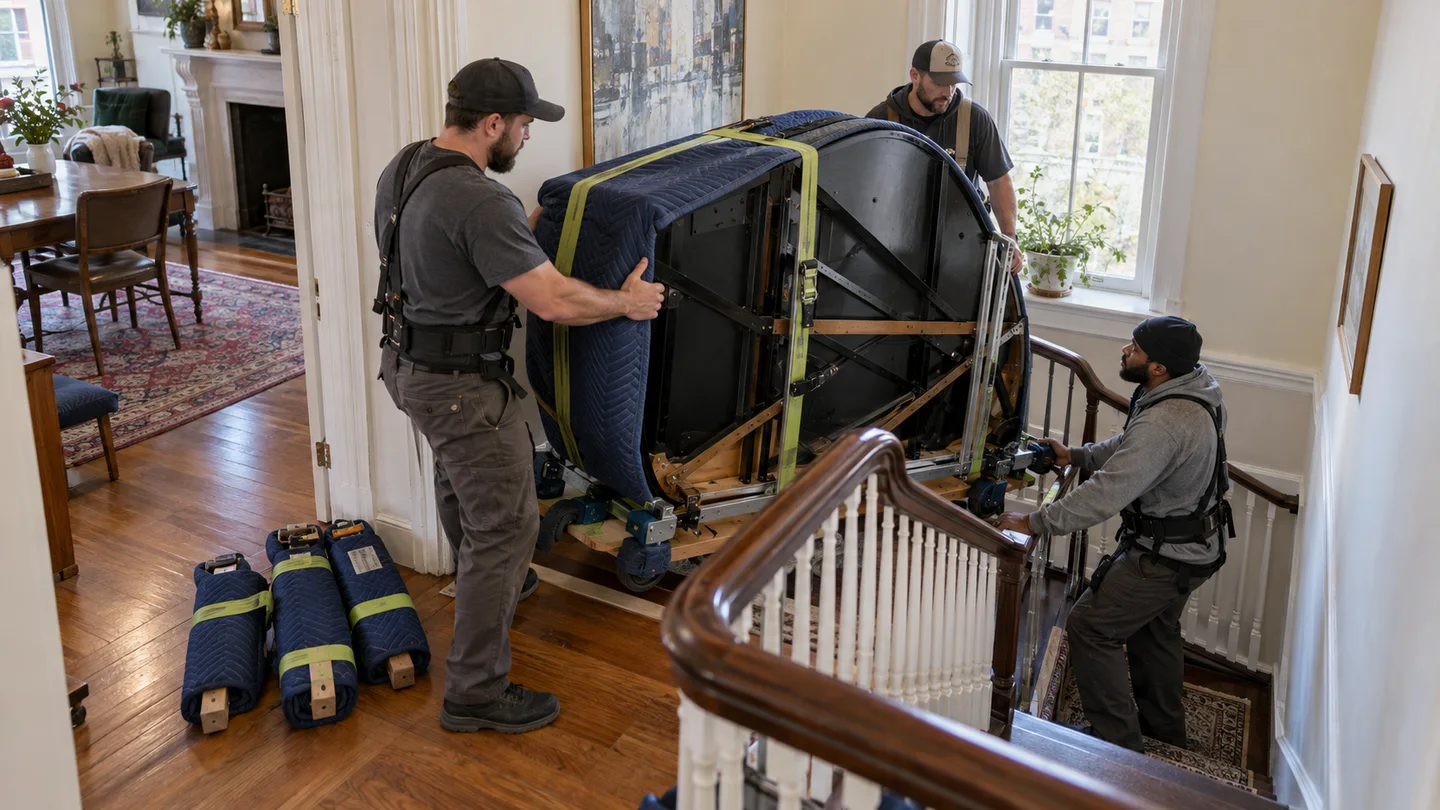
A move can be ordinary except for one piece that changes the entire transport plan. The household fits a standard truck, but the grand piano will not clear the stair turn. Or a custom dining table fits through the front door only after its top is separated from the base. A large safe, a sectional with a rigid frame, or a sculpture may create the same problem. The right question is not simply, “Can the mover take it?” It is whether the item can be prepared, carried, loaded, secured, transferred, and delivered through the exact route described in the estimate.
That distinction matters on a long haul. A difficult piece may change crew size at origin, truck position, equipment, packing, available cargo space, and the final delivery appointment. It may also require a separate specialist whose schedule does not match the main shipment. Planning those dependencies before the order is signed is far easier than discovering them while a loaded truck waits outside a residence. This guide gives you a practical way to describe the object, test both properties, compare handling plans, and keep the paperwork tied to what actually happens.
Start with a physical description, not a nickname
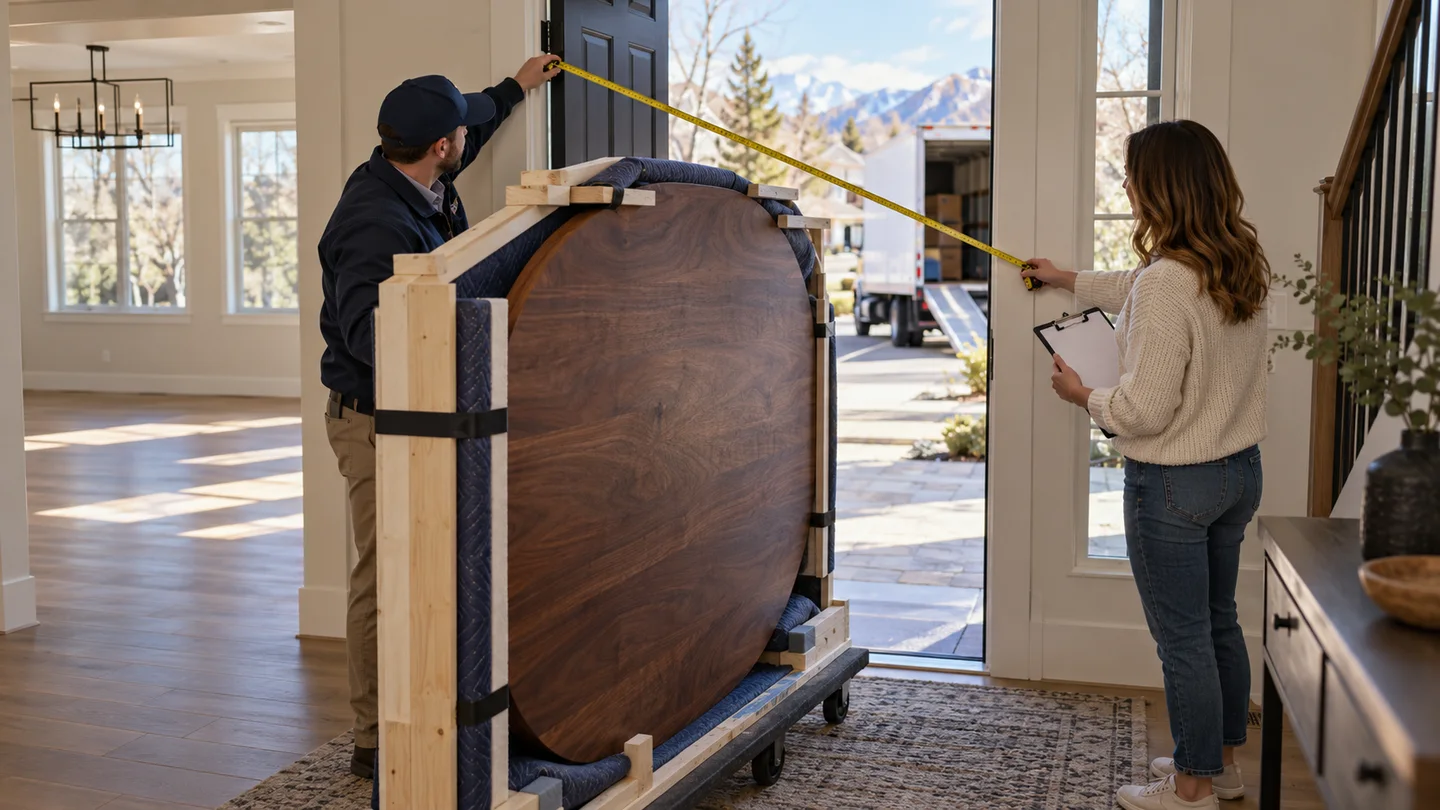
“Large armoire” tells a coordinator little. Measure the item at its widest, tallest, and deepest fixed points, including handles, feet, trim, and any projecting hardware. Record its approximate weight only if you have a credible source such as a manufacturer specification or installation document. Do not invent a weight because a form requires a number; mark it unknown and ask what information the mover needs to estimate safely. Photograph all sides, the underside or rear where lifting points may be visible, and any existing damage.
Also describe how the piece is built. A solid wood top may detach, while a stone top may need a separate crate. A piano's legs, pedals, and finish present different handling concerns from a steel safe of similar weight. A custom cabinet with glass doors has a fragile surface and a difficult center of gravity. If an owner or installer has disassembly instructions, give them to the estimator. If the item is valuable or irreplaceable, describe that separately from its mass. Value affects the protection conversation; weight and shape affect how it is moved.
Make a short item record that travels with the move file: dimensions, photos, known materials, removable parts, origin room, destination room, and your desired reassembly condition. Include the manufacturer's model or a purchase record when available. This is the baseline against which a mover can propose a real method. It also prevents a later dispatcher from receiving only a vague note such as “big table.”
Walk the entire origin path
The relevant doorway is rarely the only doorway. Trace the route from the item's current position to the truck. Measure clear openings with doors swung open, not nominal frame widths from a floor plan. Check hall corners, stair landings, ceiling height, elevator interiors, elevator door height, and the space available to rotate the object. Account for handrails, light fixtures, radiators, and door closers. If the route includes an exterior stair, note the number of steps, the width of the landing, and whether a truck can park near it.
Photos should show the approach as well as each bottleneck. A close-up of a doorway without the adjoining hallway can hide the real problem: there may be no room to pivot. Capture the street and loading area, including overhead branches, utility lines, steep driveways, and restricted curb access. Give the estimator the address-specific constraints, not just a measurement spreadsheet. If your building requires a certificate of insurance, elevator reservation, loading dock window, or protective floor covering, send the requirement early enough to affect the plan.
Do not promise that removing a door or railing solves the route. Some modifications require landlord permission, a licensed trade, or restoration work. Ask the mover who is responsible for each modification, whether it is within its services, and when it would be done. A piano or safe that cannot make a turn may need a specialist, alternate exit, or different equipment. The customer should not improvise a lift over a balcony on moving day.
Repeat the survey at the destination
A perfect pickup plan can still fail if the new property has a narrower turn or a smaller elevator. Ask someone at the destination to measure and photograph the route to the intended room. If the property is not yet accessible, obtain reliable drawings and schedule a final walkthrough before dispatch. The mover should know whether the item is going to the first floor, a basement, or an upper-level room; “deliver to the address” is not specific enough.
Think about placement after the object clears the door. A large desk may enter the room but block a doorway when assembled. A safe may require a floor-capacity review by a qualified professional. A sculpture may need a base prepared before the crew arrives. If you need assembly, anchoring, leveling, or installation, ask whether the mover performs that work, subcontracts it, or leaves the item at room entry. Write the answer into the scope. A promise to “put it wherever you want” in a sales call is not a reliable substitute for an agreed service description.
For an interstate household-goods move, the Federal Motor Carrier Safety Administration's description of accessorial services includes services such as packing and piano stair carries. Its estimate guidance says the written estimate should include transportation, accessorial, and advance charges. Use those categories to ask which part of the difficult-item work is included, which part is conditional, and which part requires a separate provider.
Request a method statement for the difficult piece
For an ordinary box, a general packing note may be sufficient. For an unusually large item, ask the mover to describe the handling sequence. Who will disassemble it? What will protect exposed surfaces? What equipment will carry it out? Where will it sit in the vehicle, and how will it be restrained? Will it be transferred to another vehicle or warehouse? What happens at destination, including debris removal and reassembly? The answers can be brief, but they should be concrete enough for the crew and the customer to recognize the intended plan.
If the plan includes crating, clarify who designs and builds the crate, whether the object is packed on site or at a shop, and whether the crate remains with it through each transfer. Ask whether the crate's dimensions change the truck space or delivery access assessment. If a specialty carrier handles the item separately, get that carrier's name, pickup window, tracking contact, destination appointment process, and liability terms. A household mover's bill of lading does not automatically explain the terms of a separate specialist.
Some items should be dismantled only by a qualified trade. Do not assume that a moving crew will disconnect gas, electrical, plumbing, or security systems. For a custom installed piece, ask its installer or manufacturer what can be safely detached. If a professional disconnection or reinstallation is required, schedule it independently and share the completion window with the mover. The route plan depends on the object being ready when the crew arrives.
Compare options by total handoffs and total cost
You may have at least three workable options: include the item in the main household shipment with special handling; hire a specialist to carry it separately; or remove it from the move. Compare these on more than the headline transportation price. Count origin preparation, packing, extra crew, building modifications, loading equipment, line-haul space, possible transfer, storage, final-mile delivery, and reassembly. A separate specialist may handle the item well but create an extra custody chain and a different arrival day. Keeping it with the household shipment may simplify tracking but require more work at both properties.
Ask for line items in writing. FMCSA says an interstate mover's written estimate must include charges for the planned services, and a binding estimate can change when additional items or services are added or unforeseen access conditions arise; the mover must prepare a new binding estimate for those changes. Do not treat a verbal “we'll work it out” as protection against a stair carry, shuttle, or crating charge. At the same time, do not insist on a false fixed price when the route has not been inspected. Give the estimator the facts needed to quote accurately, then compare the assumptions behind competing proposals.
Consider what happens if the large piece forces a different vehicle or loading order. Does the item displace other goods, requiring another truck or a split shipment? Does it limit stacking or need a protected zone? Does a specialist's pickup day come before the household's move day, leaving a gap in supervision? These are operational questions, not reasons to reject an option automatically. The best plan is the one whose handoffs and exceptions you can understand and monitor.
Clarify valuation and the item's declared value
A high purchase price does not automatically mean full reimbursement if something happens. Interstate household movers offer valuation choices; FMCSA explains Full Value Protection and Released Value. Released Value provides minimal protection, and Full Value Protection follows its own terms. Read the mover's documents before assuming that a one-of-a-kind object, antique, or piece with sentimental value is covered the way you expect. Ask how to declare high-value articles, what evidence of value is required, and whether a separate specialty carrier has different terms.
Document condition before pickup. Photograph the object in good light, including corners, finish, joints, feet, glass, and the condition of detachable parts. Save repair records or an appraisal when appropriate. At pickup, inspect the mover's descriptive inventory rather than accepting a generic “scratched” condition code that is impossible to interpret later. Note disagreement before signing. At delivery, inspect the object and its parts before the crew leaves, and follow the carrier's written claim instructions for any damage. Photos help establish what changed, but they do not replace the contract or its claim deadlines.
Avoid confusing valuation with insurance. The mover's liability option, your homeowners or renters coverage, and a specialist's policy may differ. Ask each provider what applies while the item is being prepared, carried, stored, transferred, and installed. If the object is especially valuable, seek written coverage information from the appropriate insurer or broker before the move. This is a decision to make while there is time to obtain documents, not after an incident.
Build a handoff record for every removable part
Large objects often become several pieces: piano legs and pedals, a table top and base, a cabinet's shelves and hardware. Make a labeled parts list before disassembly. Photograph each component and the packaging around it. Small hardware should go into a labeled, sealed bag tied to the item's inventory identifier, not tossed into a miscellaneous box whose destination is uncertain. Ask the crew to record all components on the inventory and to identify any crate or carton numbers.
If the large item travels outside the main household shipment, its pickup and delivery paperwork should be distinct and easy to locate. Record who accepted custody, at what address and time, and in what apparent condition. Get the tracking or order number and a contact route that works after business hours if the pickup or delivery window is narrow. At every transfer, reconcile the number of pieces. A single “piano” line is not enough when the legs, bench, cover, and hardware travel separately.
This matters particularly when delivery timing changes. If your destination is unavailable, a separate item may enter a warehouse while the main shipment goes elsewhere. Understand which party controls release and whether a new appointment or fee is required. If a delay might force warehousing, read our guide on choosing storage in transit when delivery is not yet possible. The item record you made at the start becomes the evidence for locating and releasing every piece.
Plan the calendar around the constraint
Work backward from the destination access date. Reserve any elevator, loading dock, street permit, specialist crew, crate builder, or installer before choosing a final pickup day. Ask how long the difficult-item service takes and whether the main truck can depart if it runs late. If the specialist arrives a day earlier, decide who will sign the pickup record. If delivery requires a crane or lift, confirm that the responsible provider has the permits, site access, and weather contingency it needs.
Long-haul delivery dates are often windows rather than exact appointments. Tell the mover which dates the destination can accept a large item and who can receive it. If the item needs an installer immediately after delivery, avoid scheduling that person before the carrier confirms a more precise arrival. Conversely, do not leave the delivery team waiting for a trade who has not completed a prerequisite. Assign one contact to coordinate updates, and give the carrier a backup contact in case the primary person is traveling.
If the destination changes after booking, ask for an updated order that identifies the new address and access conditions. A change from a ground-floor house to a third-floor apartment is a material change for an oversized piece. Likewise, if a late renovation blocks the room, decide whether the item can safely be left elsewhere on site or must go to storage. Ask the mover for the written terms before directing it to a warehouse. Storage charges and conversion timing deserve particular attention; see how to read the storage-in-transit clock and conversion notice.
Use a pre-pickup decision sheet
A one-page decision sheet gives everyone the same picture. It should name the item and its dimensions, list the origin and destination access constraints, identify any removable parts, show who performs each preparatory task, and state the agreed packing and handling method. Add the estimate line items, valuation choice, separate-provider contact, pickup and delivery windows, and the location of photographs or appraisals. If a question is unresolved, mark it unresolved with an owner and deadline. Do not silently turn an assumption into a commitment.
Review the sheet with the mover before pickup. Ask what would cause the crew to stop and call for authorization: an unexpected stair turn, an item heavier than described, a closed loading dock, or evidence that disassembly is unsafe. Specify who can authorize an added service and how the revised price will be documented. FMCSA's guidance says movers should tell customers before or at loading if they reasonably expect a special or accessorial service will be necessary for safe transport. That is a useful checkpoint, but a thorough survey should surface foreseeable requirements earlier.
At loading, compare the actual object and access route with the estimate's assumptions. If the plan no longer fits, pause before the item is dismantled or removed. Get a revised written plan and cost where required. A crew should never be pushed into an unsafe improvisation because the truck is scheduled to leave. An extra hour of coordination is less costly than damage to a building, a person, or a difficult-to-replace object.
A worked example: one grand piano in a household move
Suppose a family is moving from a rowhouse in Philadelphia to a suburban home in Colorado. Most goods are ordinary cartons and furniture. The grand piano sits on the second floor, reached through a narrow hallway and a 90-degree stair turn. The Colorado house has a ground-level entrance but a short sloped path and a smaller front door than the family expected. A simple household inventory that says “one piano” misses nearly all of the relevant work.
The family photographs the piano, measures its dimensions, records the brand and model, and asks a piano technician about safe preparation. They send both properties' route photographs to the estimator and schedule an in-person access review. The mover explains whether its own specialist or a subcontractor will remove the legs, protect the cabinet, descend the stairs, load and restrain it, and reassemble it. The estimate names the stair carry and any specialty packing. At destination, a local contact confirms that the selected entrance and intended room can accommodate the protected piano. The family asks for the specialist's order number and confirms whether the piano will stay with the household shipment or travel separately.
If a specialist carries it separately, the family builds two calendars and two sets of delivery contacts. They photograph condition before pickup, match each removable part to an inventory line, and keep the household mover's and specialist's documents separate. They also establish who will receive the piano if the rest of the shipment arrives first. This plan does not guarantee that no problem will occur. It turns a vague “special item” into a set of accountable steps that can be checked.
Questions to ask before signing
Ask the estimator to show where the item appears in the survey and which dimensions and access notes were used. Ask which exact services are included at origin, in transit, and at destination. Identify any specialist by name and clarify whether you contract with it directly or through the household mover. Ask whether the item will be transferred, warehoused, or delivered on a different day. Confirm how many pieces will appear on the inventory after disassembly, who will reassemble them, and what happens if a component is missing.
Ask what would change the quoted price and how you would approve the change. Review the valuation selection and any high-value declaration. Ask how damage, delay, and lost parts should be reported and which provider handles each claim. Finally, ask what the crew will do if the route is unsafe or the destination cannot accept the item. A reliable answer includes a call, a written decision, and a feasible alternative. It should not depend on the customer making a rushed choice at the curb.
The larger the item, the more useful a simple principle becomes: every unusual handling step should have an owner, a price or pricing rule, and a written handoff. With those details settled, the large item can be planned as part of the transport system rather than treated as a surprise attached to an otherwise routine move.
Check the current rule, contract and source page for your route and service. This guide helps you prepare clear questions and records.