
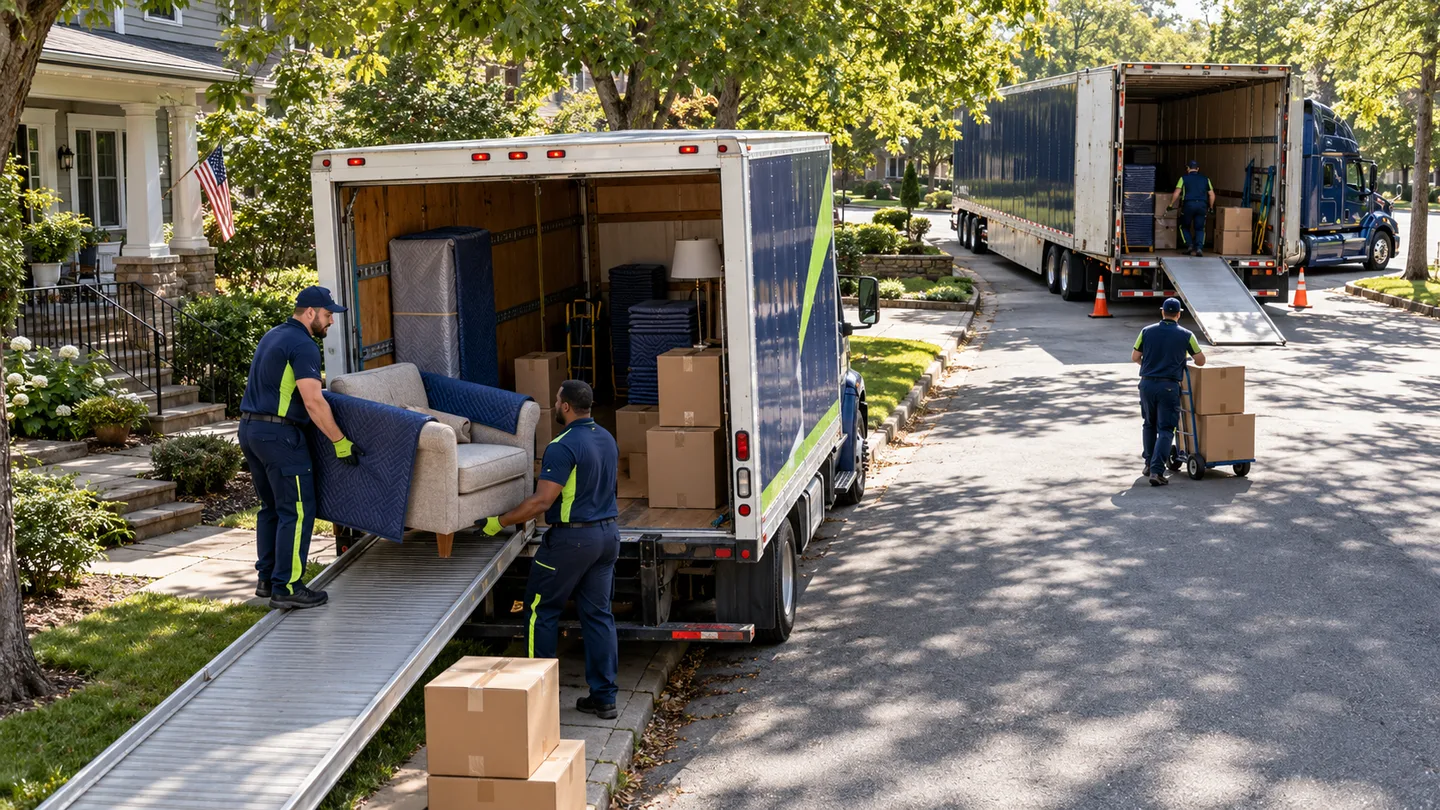
A tractor-trailer can travel across several states and still be unable to reach the front door. The destination may sit on a narrow street, behind a low tree canopy, inside a gated development, or at the end of a steep driveway. At the origin, a similar restriction may prevent the large truck from loading directly. A mover may then use a smaller vehicle to carry the shipment between the home and a place where the line-haul truck can park. That transfer is commonly called a shuttle.
A shuttle changes more than the last few miles. It adds handling, people, equipment, scheduling, and sometimes a charge. It can also change when a receiving person must be available. The useful time to discuss it is before the carrier sets the truck assignment, not when the driver is looking for a legal place to stop. Give the mover a factual description of both addresses and ask for a written access plan. A household cannot know every vehicle dimension or local rule, but it can identify conditions that warrant inspection.
For covered interstate household-goods moves, the Federal Motor Carrier Safety Administration (FMCSA) defines shuttle service as using a smaller vehicle to serve a residence that the mover's normal line-haul vehicle cannot access. FMCSA also describes impracticable operations, which may require smaller equipment or extra labor. Those definitions do not set one universal shuttle price. The carrier's tariff and the actual contract matter. A self-service container or truck-rental product may use different terms and pricing, so compare the service agreement for the product you booked.
Identify the physical constraint, not just the neighborhood

A postal address says little about truck access. Send the mover photos of the approach from both directions, street signs, curb space, driveway entrance, overhead wires or branches, and the loading location. Include building rules, gate hours, garage clearances, and whether a truck can legally stop. If a street appears wide in an online map but is narrowed by parked cars on weekdays, say so. If a bridge has a posted limit, photograph the sign. Do not guess that a trailer can pass because a delivery van once did.
A useful access description answers four practical questions. Can the assigned line-haul vehicle enter the street? Is there a legal place to stop near the residence? Can the crew move goods safely between that place and the door? Can the vehicle leave or turn without backing through an unsafe area? The carrier may need its driver or local agent to assess details you cannot determine. Ask it to state which factor creates the shuttle requirement and what size vehicle it plans to use.
The same street can be accessible at one time and blocked at another. A school pickup zone, street market, snow emergency, or construction closure may change the usable space. Ask the building manager or local authority about parking restrictions for the actual move date. A permit may be needed even where the road is physically wide enough. A permit does not necessarily make an oversized truck legal or safe. Treat parking permission and vehicle access as separate questions.
Ask for the vehicle plan at both ends
A shuttle may occur at origin, destination, or both. For an origin shuttle, a smaller truck loads at the home, drives to the line-haul vehicle, and transfers the goods. At destination, the process runs in reverse. Ask whether the transfer happens in a yard, a legal roadside staging area, or a warehouse; who supervises it; and whether the goods remain together during the handoff. If the carrier uses two small vehicles or multiple trips, ask how the crew will separate and account for the loads.
Some carriers use a local agent to handle the final delivery. Others keep the same driver with the shipment. The name on the smaller truck may differ from the brand on the estimate. That can be legitimate, but the relationship should be documented before the unit appears. Record the legal carrier or agent, the booking number, and the vehicle or container identifier. When a transfer is planned, ask what paperwork will show the physical movement of the goods and who signs it.
A portable-container provider may handle a tight street by placing a container at a nearby approved location, transferring goods in a smaller truck, or declining that address. Its operational options are product-specific. Do not assume the FMCSA household-goods shuttle rules describe every container booking. Ask where possession and responsibility change, whether the container itself moves to the residence, and whether the transfer requires separate labor or storage.
Get the price and trigger in writing
Ask the mover to show the estimated shuttle charge as a separate line or explain why it is included in a package price. Clarify whether it is based on labor time, shipment weight, the number of trips, the smaller truck, distance from staging to home, or a tariff rule. Ask what happens if access is better than expected and the shuttle is unnecessary. Conversely, ask what written notice and price calculation apply if a shuttle becomes necessary only on delivery day.
FMCSA's estimating guidance says a covered interstate binding estimate must describe the shipment and services. It also explains how charges for impracticable operations can be collected. For these moves, the amount of such charges due at delivery is capped at 15 percent of other charges due at delivery, with a remaining balance billed later. That is a limit on collection at delivery, not a promise that the total shuttle service costs only 15 percent. Read the estimate and carrier tariff, and request a written calculation for a specific charge.
Do not collapse every access charge into “shuttle.” A long carry may be charged when the truck parks far from the residence. Stairs, elevators, waiting time, permits, and storage can have their own terms. FMCSA's general glossary treats line-haul and accessorial charges separately. Ask which actual service each line item pays for. A small truck might be necessary because of a narrow bridge even though the home is only a short walk from the curb; a long carry could arise without a shuttle if the normal truck can park on the street but far from the door.
Keep the complete revised estimate, not only a screenshot of a price. It should show the route, shipment, services, payment terms, and who authorized a change. If the salesperson says the access fee is waived, ask for that in the order or a written amendment. If the carrier cannot assess the address until dispatch assigns equipment, request the decision point and an advance notice method. The aim is to replace a vague “extra charges may apply” warning with a known trigger and process.
Separate access planning from a price dispute
A mover cannot safely send a truck through a route it judges impossible. The household should not pressure a driver to ignore a bridge limit, block an intersection, or attempt a turn that puts people or property at risk. If the access plan is disputed, ask for the observed restriction, the assigned vehicle dimensions, and the alternatives available. A different lawful loading area, a smaller truck, a different appointment, or a carrier with appropriate equipment may solve the problem. Which option works depends on the address and contract.
Before loading, FMCSA's pickup guidance says a covered interstate mover must inform the shipper if it reasonably expects a special or accessorial service is needed to transport the shipment safely. If you decline a service the mover reasonably considers necessary, it must make a written note and may refuse the shipment under the stated conditions. This is a reason to surface the restriction before pickup. It is not an invitation to accept an unexplained charge without asking how the service will be performed and billed.
If a destination-only problem appears after the goods are already moving, call the carrier's official dispatch or customer-service channel. Request the access assessment, the proposed transfer point, the revised delivery appointment, and the expected charge in writing. Do not rely solely on a text message from a driver whom the office cannot identify. The carrier should be able to connect the service to the shipment number and the billing document. Keep a copy of the original access information you supplied so the conversation starts from facts.
Protect inventory through the transfer
Each additional handling step is an opportunity to misplace a carton or separate parts of a furniture piece. Before an origin shuttle leaves the house, use the carrier's inventory or a detailed household list to count pieces. Label cartons clearly, keep a list of items loaded in each trip, and photograph the loaded small vehicle if permitted. At the line-haul transfer, ask the crew to reconcile the inventory before the small truck departs. Do not assume that “everything from the garage” is a sufficient manifest.
At destination, have the receiver use the inventory while goods move from the shuttle vehicle into the residence. Check high-value or awkward items by description and condition, not only carton count. If the shuttle makes multiple trips, record which trip carried each large item and the number of cartons received. A missing box is easier to trace while both vehicles and crews are still on site. Note exceptions on the delivery paperwork and keep copies of signed records.
If goods go through a warehouse between the home and the line-haul vehicle, ask whether that is a short staging transfer or a storage service. The distinction affects custody, scheduling, and possibly cost. Our guide to origin warehouse handling explains how to document a facility handoff. Ask for facility identity, arrival and release records, handling inventory, and an expected departure date. A household should know whether its goods are still on the same day’s shuttle or have been placed in storage pending a later line-haul leg.
A shuttle does not automatically mean the carrier will break a container seal or repack every item. Ask what physical transfer is planned. If a sealed unit is moved intact on a different chassis, record the seal or container number; if loose goods move between trucks, record both vehicle IDs and transfer documentation. The number of handoffs matters because it tells the household where to look if a part of the shipment is late. Avoid making an assumption from a dashboard status that simply says “in transit.”
Reserve enough time for the actual work
A smaller truck has less capacity. One line-haul load may require several local trips, with loading and unloading at each end. Ask the mover for its expected number of trips and the crew hours at the residence. The answer is an operational estimate, not a guaranteed minute-by-minute schedule. A high-rise elevator reservation may need to cover the full shuttle window. If the building grants a short loading slot, tell dispatch before it confirms delivery.
Plan around the location where the line-haul truck can wait. If that site has limited hours or no overnight parking, a delayed transfer can affect the delivery date. The driver may also have operating-hour limits. Let dispatch arrange the legal sequence; a homeowner should not suggest an unauthorized roadside transfer merely to preserve an elevator slot. Confirm the next available building appointment if the planned transfer cannot be finished on time.
The receiver should know which vehicle will arrive at the residence, the approximate number of trips, the crew or agent name, and the payment arrangement. Arrange building access for all trips, not just the first. If a key, loading-dock badge, or curb permit is valid for a narrow time, keep a responsible person available to extend it or reschedule. An apparently simple final-mile transfer can stall because the second trip has no gate code.
Compare alternatives before committing
A shuttle may be the only practical way to serve the address, but there are other possible service designs. The carrier might use a smaller line-haul truck, a straight truck for the entire shipment, a portable container dropped at a permitted location, or a customer-accessible terminal handoff. Each changes capacity, handling, delivery dates, labor responsibility, and price. Ask for a comparable written scope, not just a lower headline quote.
If the household can safely receive at a storage facility or terminal, determine who unloads and transports the goods from there. A “terminal delivery” price does not solve the last mile by itself. Check whether the facility permits public access, what equipment is needed, how long goods may remain, and when carrier responsibility ends. The cheapest line item may require the household to hire another truck and crew. Compare the complete path to the residence.
If the proposed alternative places your goods with other shipments, ask how the provider will keep your cartons and furniture separate at the transfer point. A shuttle-to-warehouse route can add a consolidation step even when the household expected a direct line-haul trip. The consolidation and inventory guide explains the identifiers and handoff records to request. Include the extra handling and delivery spread in the comparison, not only the shuttle fee.
For a container service, ask whether parking a unit on the property is allowed and how long it may remain. A no-parking street can make a direct container drop impossible even where a small vehicle could stop briefly. A driveway may support a container but not a large tractor-trailer. These distinctions can produce a workable alternative; they should be checked with the provider and local property rules rather than inferred from a photograph alone.
Use an access checklist before booking
At each address, note the usable curb length, street width where cars are normally parked, overhead clearance, posted limits, turn and backing space, driveway grade, stair or elevator route, loading dock measurements, gate hours, and permit rules. Photos are often more useful than a guess at dimensions. Give the carrier the photos and ask it to identify what remains unknown. A site visit or local-agent review can resolve uncertainty for a difficult entrance.
Ask the carrier to state its assumed vehicle type and where it expects to park. If it plans a shuttle, record the transfer point, smaller vehicle, crew, estimated trips, inventory method, price basis, and who will confirm the appointment. If the plan is conditional, request a clear condition: for example, “shuttle if the assigned road-haul vehicle cannot legally enter the private lane,” followed by who assesses that condition and when. Avoid accepting a condition that depends on a hidden or undefined decision.
Give the same description to each competing mover. One quote may include an origin shuttle while another assumes direct loading. Those are different jobs, so the prices cannot be compared until the access scope matches. If one company claims no shuttle is needed, ask which vehicle it will use and where it will park. A more precise plan is more valuable than a confident verbal assurance. Keep the written answers with the estimates.
Manage a late discovery at the destination
If the truck reaches the destination and cannot approach, first make sure it stops in a lawful, safe place. Ask dispatch for the documented access issue and proposed next step. The carrier might arrange a smaller vehicle, move the appointment, or use a local facility while it schedules final delivery. Get the location of the goods and the expected handoff time. Do not assume that a scan at the destination city means the shipment is available at the residence.
Ask whether the delivery window in the bill of lading is still achievable. FMCSA's delivery guidance explains how certain charges are collected for covered interstate moves, and its pickup guidance tells households to agree on definite pickup and delivery dates. A revised access plan should identify a definite next appointment or the process for setting it. The receiver can then decide whether to retain an elevator reservation or temporary unloading help.
Do not sign a delivery receipt for goods that have only reached a staging yard. If the carrier asks for a document acknowledging the local transfer, read what it says and keep a copy. A receipt for physical custody at a facility is different from a clean delivery receipt for all goods at the home. At final delivery, reconcile inventory and condition before the crew leaves. If a piece is missing or damaged, note the exception according to the carrier's paperwork and retain photographs.
Keep the decision easy to hand off
The person who booked the move may be traveling while the shuttle operates. Give the receiver a one-page access plan with the address, building contact, shuttle crew or agent, expected vehicle, transfer point, trip count, inventory reference, payment instructions, and escalation number. Update it when dispatch changes a detail. Keep older versions so the reason for a new charge or date is understandable. Do not send access codes to an unverified caller.
Ask one responsible carrier contact to confirm that the origin office, driver, destination agent, and billing department share the same shuttle plan. A sales estimate can be accurate yet fail operationally if dispatch never receives the alley photos or the destination agent thinks the building dock accepts a tractor-trailer. The purpose of the plan is to give each party the physical facts needed for its part of the move.
Shuttle service is a practical answer to a real access limit. It works best when the household and mover identify the constraint early, price the actual handling, document the transfer, and reserve enough time for every trip. The last mile should have the same clear custody and inventory record as the long interstate leg, even though it happens close to home.
Check the current rule, contract and source page for your route and service. This guide helps you prepare clear questions and records.