
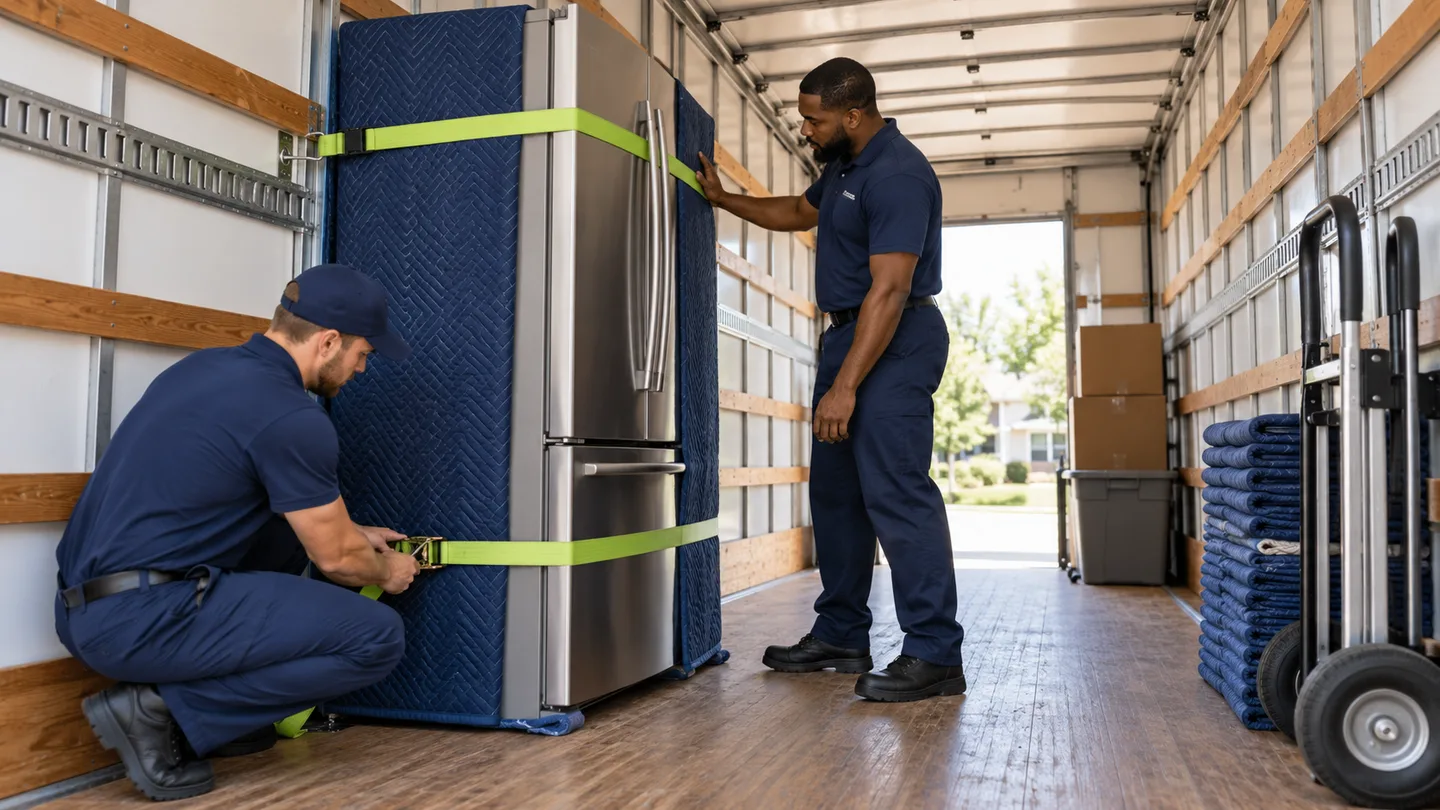
A refrigerator, washer, dryer, or range can look like a single line on a moving inventory. In practice, each has a preparation step at the old home, a path through doors and stairs, a specific way to ride in the truck, and a reconnection step at the new home. The shipping leg is only one part of the job. A mover may carry the appliance but not disconnect a gas line, install washer shipping bolts, remove a built-in unit, or reconnect a water supply. Confirm the division of work before moving day.
Start with the appliance model numbers and manuals. Manufacturer instructions can differ even within one product category. GE Appliances says many refrigerators should travel upright and gives model-specific exceptions for short side transport; Maytag says front-load washers need shipping bolts reinstalled to protect the suspension while moving and removed before use. Those details are more useful than a generic internet rule about “always wait four hours” or “a washer can ride on its back.” Keep the instructions for the actual model with the moving paperwork.
A good appliance plan has six parts: decide whether it is worth moving, measure the full route, schedule safe disconnection, prepare the interior and moving parts, agree on truck handling and inventory condition, and schedule reconnection and testing. Missing any one part can turn a paid transport service into an unusable appliance at destination.
Decide whether this appliance should travel
Compare the appliance's age, condition, replacement cost, expected remaining life, and the cost of moving plus installation. A large refrigerator that will not fit the new kitchen has no value as a transported item. A front-load washer may need model-specific shipping bolts and a compatible outlet or drain at destination. A gas dryer may be incompatible with an electric-only laundry space. Check the new home's connections and dimensions before paying to move a heavy unit.
Record model and serial numbers and photograph the appliance operating, if practical, before disconnecting. Note existing scratches, dents, loose handles, leaks, unusual noise, or display faults. If it is already broken, tell the mover; a transport claim cannot turn an old fault into new damage. Keep purchase records and a realistic value estimate when deciding on protection. A replacement-price assumption can be misleading for an older machine.
If one appliance is oversized or unusually heavy compared with the rest of the load, discuss it separately at the survey. The long-haul oversized-item guide explains how a single item can change equipment, crew, and access assumptions. A side-by-side refrigerator, commercial range, or stacked laundry unit may require more than the standard two-person move. A mover who first sees it on loading day may revise the plan or decline unsafe handling.
Measure the entire access path
Measure the appliance's height, width, depth, and weight from the manual or product plate. Include handles, door swing, hinges, leveling feet, and any attached pedestal. Then measure doorways, hallway turns, stair landings, elevator interior, loading-dock opening, and the new home's route. A doorway width alone is not enough; the appliance may need to pivot around a corner. Ask whether doors can be removed by a qualified installer and whether doing so affects warranty or reconnection.
Photograph tight spaces at both homes and share them with the mover before the estimate is final. Note stairs, uneven walkways, steep driveways, soft flooring, and building restrictions. Confirm whether the mover will use a suitable appliance dolly, floor protection, and additional crew. Do not volunteer to steady a heavy unit on stairs when the crew lacks personnel. A crushed finger or dropped refrigerator is a costly price for avoiding an access charge.
At destination, verify that the unit will fit after it is unwrapped, with enough clearance for ventilation, water lines, door opening, and service access. A refrigerator can physically fit between cabinets yet fail to open fully. A washer can fit in a closet but leave no room for the drain hose bend. The installation manual, not just the shipping dimensions, determines the usable space. If the destination is not ready, arrange a safe holding location rather than blocking an exit or forcing a rushed reconnection.
Assign disconnection and reconnection work
Ask the moving company exactly what its crew will do. Many crews will move a disconnected appliance but will not touch gas, plumbing, hardwired electrical connections, or built-in cabinetry. Book a qualified technician or licensed trade professional where required by the appliance and local rules. Gas dryers and ranges deserve particular care; do not let a general moving laborer improvise a gas disconnection or reconnection. Shutoff, capping, leak testing, and installation should follow the manufacturer instructions and applicable local requirements.
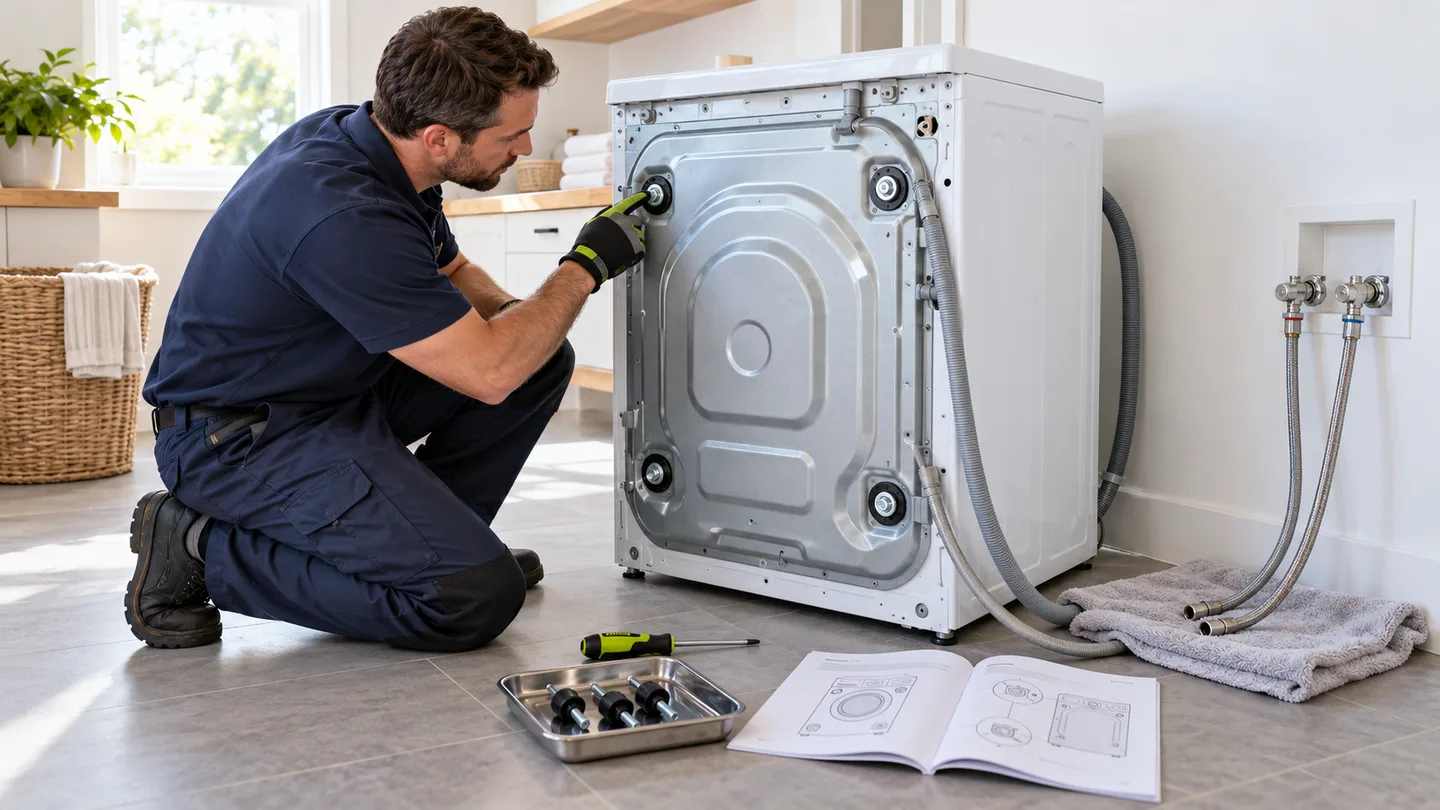
For a washer, shut off water, disconnect hoses, and drain residual water according to the manual before transport. Keep a bucket and towels ready. A front-load washer needs its transport or shipping bolts reinstalled for the move where the manufacturer requires them. Maytag recommends an authorized service technician for this step on its models. Do not operate the washer at destination until the bolts are removed as instructed; running it with them installed can damage the machine. Label the bolts and keep the removal instructions with the unit.
For a refrigerator or freezer, plan time to empty, defrost if required, clean, dry, and secure shelves or drawers. Disconnect an ice-maker water line correctly and protect it from kinks or leaks. Remove perishables rather than transporting them inside. Photograph the water connection before it is taken apart if a technician will reconnect it later. Tape should not be placed directly on a finish that could be damaged; ask the mover how doors and removable parts will be secured. Keep the owner's manual and any special hardware in a clearly labeled bag that travels with you or is inventoried.
Keep the manufacturer's transport orientation
An upright refrigerator is easier to protect than one laid on its side, and some models must remain upright in a vehicle. GE Appliances says French-door, bottom-freezer, compact, and built-in designs have stricter upright requirements than some other styles. For certain permitted side transports, GE gives a stand-upright waiting period before power is connected; the time depends on how long the unit was on its side. Do not apply that rule to every refrigerator. Check the model guidance and tell the mover before loading if the unit must not be laid down.
A washer's internal tub and suspension are another concern. Maytag instructs owners to reinstall shipping bolts for front-load washer transport and keep the appliance upright. The bolts are not packing material that a mover can replace with blankets. If you no longer have the correct kit, order it in advance for the exact model or ask a service technician. Do not schedule the move assuming the crew can source bolts that morning. A top-load washer may have different instructions; read its manual rather than copying front-load steps.
For a dryer or range, secure loose racks, drums, doors, and cords or hoses according to the manufacturer. Do not disconnect or move a built-in or gas appliance before the responsible technician confirms it is safe. A large unit may need a pallet or custom protection. Ask the mover how it will prevent rolling, tipping, and pressure on protruding controls during the truck leg. The goal is to carry the appliance in the orientation and configuration its maker expects.
Protect and inventory at the truck
Before the appliance leaves its room, take clear photographs of all sides, handles, doors, control panel, and any visible preexisting mark. Check that the mover's inventory identifies the unit and its condition, not just “appliance.” Note a dent in a specific panel or a missing shelf. FMCSA's interstate moving guidance tells consumers to accompany the crew during inventory and resolve condition questions before signing. Preserve a copy of the inventory with your own photos.
Ask how the unit will be wrapped and secured in the truck. It should not ride where loose boxes can crush controls or where a strap bears directly on a fragile handle. A refrigerator on casters needs its wheels immobilized. A washer needs its drum restrained as instructed. A tall unit may require anchoring against tip. The mover decides the specific loading method with its equipment, but you can verify that the method is consistent with the manufacturer's orientation and that the crew has room to move safely.
Do not pack loose cookware, detergents, chemicals, or documents inside an appliance unless the mover expressly accepts it and the manual permits it. Unsecured contents can damage interiors, leak, or make inventory unclear. The refrigerator's shelves should be protected as components, not used as storage for jars. Keep any small removed parts—bolts, hoses, fittings, keys—in a labeled bag with a documented custody plan. A critical fitting lost in a miscellaneous box can delay installation for days.
Bridge the gap if the new home is not ready
Sometimes the appliance reaches the destination before the kitchen or laundry room is usable. A new floor may not be finished, a gas line may await inspection, or the apartment elevator may be unavailable. Ask the mover about storage-in-transit before loading, including where the item will be held, how it will be inventoried, extra handling, and delivery charges. The storage-in-transit decision guide helps compare that option with a delayed move or separate local storage. Do not leave an appliance in a damp garage or on a balcony without checking the manufacturer's storage limits.
If storage is necessary, make the preparation more complete. Water left in washer hoses can leak or freeze. A refrigerator interior should be dry enough to avoid odors and mold. Keep doors secured for transport but ask how the storage provider prevents trapped moisture during a long hold. A technician may need to repeat checks before reconnection. Update the destination appointment as soon as the space is ready and make sure the mover knows whether another crew or truck will make the final delivery.
Storage adds a second condition handoff. Record the appliance when it enters the warehouse and when it leaves, not only at origin and final home. If a refrigerator door is dented after two transfers, dated photographs and inventory notes help establish when the change appeared. Read the storage paperwork and valuation terms rather than assuming the original moving estimate covers every later handling event in the same way.
Resolve building rules and weather before the truck arrives
An apartment or condo may require a freight-elevator reservation, a certificate of insurance from the mover, floor protection, restricted move hours, or a designated loading entrance. A heavy refrigerator may fit the elevator but exceed the building's permitted moving procedure, and a washer may need to be carried down a narrow stairwell. Ask management for written rules, send them to the moving company, and reserve enough time for the appliance's actual route. If the crew arrives and the only elevator is unavailable, the unit may be held on the truck or placed in storage under terms you did not expect.
Check the path in both weather extremes. Rain can make outdoor steps slippery and wet cardboard unreliable. In freezing weather, residual water in a washer, ice maker, or hose can expand and damage components. Follow the appliance manual's winterizing or drain instructions when the unit may wait in an unheated truck or warehouse. Do not pour antifreeze into an appliance without manufacturer guidance. A mover may know how to protect its truck floor but not how to winterize your particular machine; assign that task to the right technician.
A large appliance may also create a tipping or pinch risk during threshold transitions. Keep children, pets, and bystanders away from the crew's path. Clear rugs, plants, and loose boxes before the movers arrive. Tell the foreperson about fragile flooring or an uneven step and ask what protection the crew will use. If a door must be temporarily removed, identify who will remove and reinstall it, and document the door and frame before work begins. A scratch to the house and a dent to the refrigerator have different records and may involve different parties.
At destination, avoid signing the appliance as “installed” if the mover only placed it in the room. If the service order promises placement, confirm the final position and any leveling the mover actually performed. If reconnecting is a separate technician appointment, write that down. A refrigerator standing in its alcove with no water connection and a washer with shipping bolts still fitted have been delivered but are not yet ready for ordinary use. That distinction prevents a rushed first test from creating a problem after the moving crew has left.
Reconnect and test deliberately
At delivery, inspect the exterior before signing the inventory. Note new dents, cracked trim, loose controls, missing shelves, or crushed hoses. Photograph the condition while the mover is present. Then follow the manufacturer's wait and setup instructions. If a refrigerator traveled on its side contrary to plan, record that fact and check model-specific guidance before plugging it in. Do not use a one-size-fits-all waiting period. If the washer's shipping bolts remain installed, arrange removal before running it.
Have a qualified person reconnect gas, water, or hardwired electrical service as appropriate. Check for leaks and correct drainage after installation. A refrigerator may need time to reach safe food-storage temperature; use a thermometer rather than assuming it is ready because the light turns on. A washer should be leveled and tested for leaks and vibration before a full load. Keep installation receipts and note any fault observed immediately. A post-move problem can arise from transport, reconnection, an old defect, or a combination; a documented sequence helps determine what happened.
Do not discard packing, parts, or damaged components before a claim inspection if there is a problem. Notify the mover within the contract's process and deadlines, keeping the pickup inventory, delivery notes, photos, and technician findings together. An interstate mover's valuation choice affects how loss or damage is handled; understand it before loading day. A signed delivery record and a repair invoice support the facts but do not guarantee a particular settlement.
Use one appliance-specific worksheet
For each large unit, record model, serial number, dimensions, destination location, required technician, disconnect date, transport bolts or other hardware, orientation limits, access concerns, inventory condition, and reconnect appointment. This worksheet gives the mover, technician, and receiver one shared picture. It also exposes a missing task early: if the washer bolts are unavailable or the new refrigerator alcove is too narrow, you can resolve it before the truck arrives.
Heavy appliances move successfully when the transport leg is connected to preparation and installation. The mover can carry and secure a unit, but the customer must give accurate model information and arrange the work outside the mover's scope. Measure the path, follow the manufacturer's instructions, document condition at each handoff, and do not restart a machine before it is ready. That is the difference between delivery and a working home.
Sources and scope
This guide relies on GE Appliances' refrigerator moving instructions, Maytag's front-load washer moving guidance, Maytag's shipping-bolt guidance, and FMCSA's moving checklist. Manufacturer directions vary by model; use the actual manual and qualified trade help for disconnection and installation.
Check the current rule, contract and source page for your route and service. This guide helps you prepare clear questions and records.