
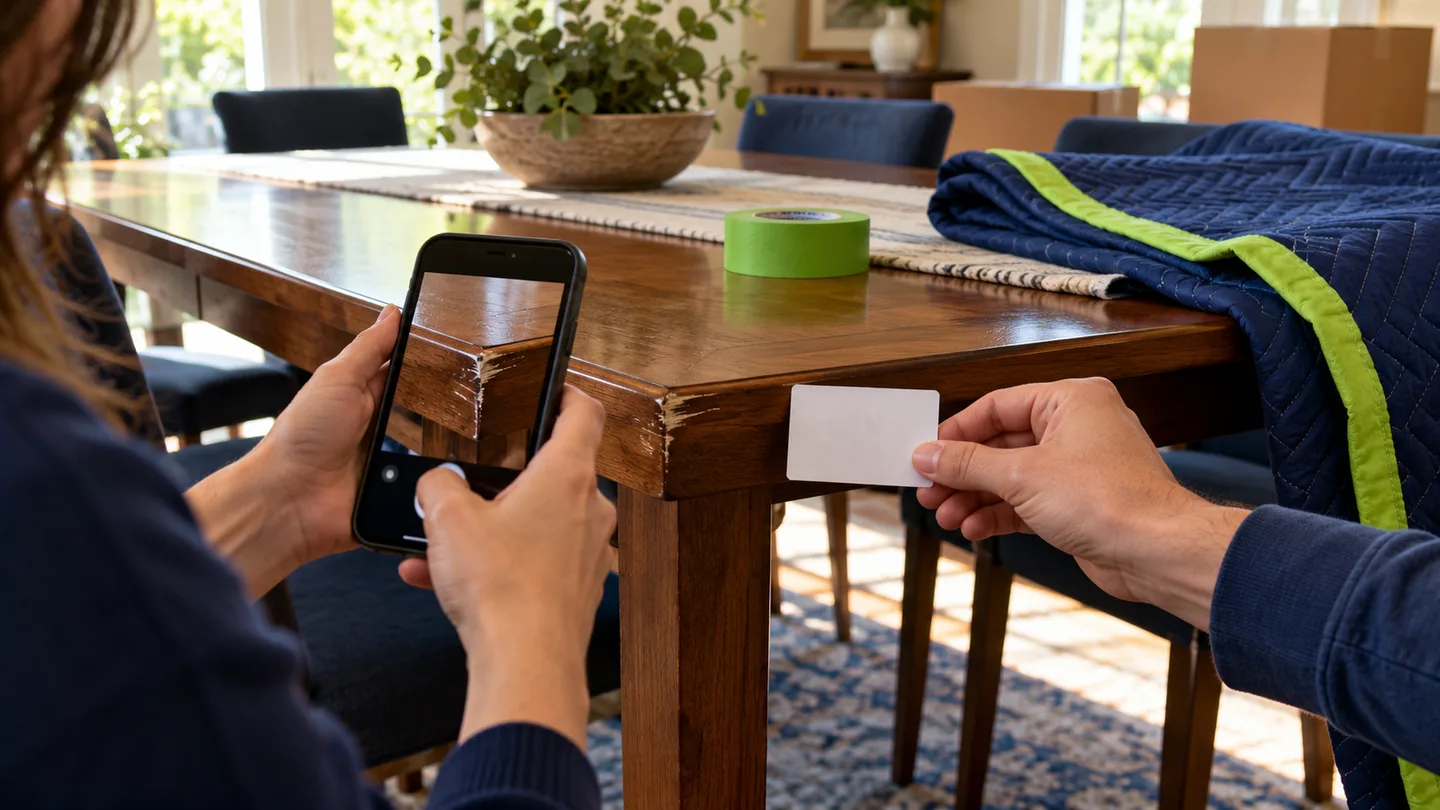
A closed container hides the shipment that matters most: the individual goods inside it. When a container or customer-loaded trailer reaches its destination, a scratched table, broken lamp, missing carton, or wet upholstery can be difficult to place in time without a reliable origin record. A good condition record does not guarantee a claim will be paid. It gives the household, transport provider, and any hired loading crew a common description of what entered the shipment and how it looked when the doors closed.
Make that record while the goods are still visible. List significant items, assign identifiers to cartons, photograph pre-existing wear and vulnerable surfaces, and capture the loaded container before sealing. Keep the container or trailer number, lock or seal detail, pickup date, and provider documents with the same file set. FMCSA's household-goods pickup guidance requires an interstate household-goods mover to prepare an inventory before or at loading and stresses reviewing every condition notation before signing. Customer-loaded container arrangements may have different contracts and responsibilities; check the actual provider's terms rather than assuming that every carrier creates the same inventory.
The aim is accuracy, not a massive photo dump. A few clear images of each important item and a searchable list can be more useful than hundreds of blurry, unlabeled photos. The record should be detailed enough to tell a claim handler which item is involved and whether a mark was already present, without delaying loading for hours.
Decide which record the provider will create

Ask the carrier whether it prepares an item-level inventory, a container-level receipt, both, or neither. A full-service regulated mover often records the condition and number of individual pieces. A customer-loaded container provider may acknowledge only the container, its ID, and its pickup. Those are different records. If the carrier will not inspect each item, create your own item-level inventory and preserve the provider's equipment and custody documents separately. Do not describe your personal list as a carrier-verified inventory unless the carrier actually reviewed and signed it.
Obtain the provider's current claim procedure and contract terms before loading. Who is responsible for packing and securing? What loss or damage protection applies, and are exclusions specific to customer loading or prohibited goods? Does the provider need a declaration for high-value items? How and when must a problem be reported? These terms vary. FMCSA's loss and damage guidance gives deadlines and claim steps for covered interstate household-goods moves, but it should not be copied wholesale onto a self-service agreement with different legal treatment. Read the actual written service and coverage documents.
Keep separate copies of any contract, booking confirmation, payment receipt, equipment inspection, and later bill of lading or pickup receipt. A condition photograph without a shipment identifier is less persuasive; a receipt without item detail does not show a table's prior condition. The two records complement one another. Assign one household member to maintain the combined set so photos and documents do not remain on different phones with conflicting file names.
Build an item-level inventory people can use
Give large and valuable pieces a simple identifier such as L01 for living room sofa or D03 for dining table. The code needs only to be unique within this shipment. Write the name, room, approximate description, and any existing damage. Include serial numbers for electronics or appliances when available, but keep those numbers in a private file. For cartons, number each box, note its source room and broad contents, and mark fragile or special-handling items. Do not publish a detailed list of valuables on the outside of a container.
Record what will not be loaded. A bicycle taken in a personal vehicle or a lamp left with a neighbor should not appear as missing at delivery. If an item changes plans on loading day, update the inventory then. A check box for loaded, carried separately, or removed from move makes this easier. Count boxes at the doorway as they enter and compare with the packed-room count. An unexplained gap is easier to investigate while the home and truck are both open.
For a disassembled item, link the components. A bed frame may travel as headboard, footboard, rails, slats, and a hardware bag. Give the set one parent code with part counts, and photograph the bag next to the frame label. If a mover packs a fragile piece in a crate, record the crate number and the item inside it. The inventory should help the destination crew match pieces without opening every carton.
Avoid false precision. If a carton contains mixed kitchenware, say that rather than listing ten glasses from memory. If a drawer remains inside a dresser under the provider's rules, note it. Do not call an item “excellent” if one leg is loose. The record gains value from candid detail, including damage that occurred before the move. Honest origin notes make a later new mark easier to identify.
Photograph condition before protection hides it
Take an establishing photograph of each important item in its room, then closer images of the areas most likely to be questioned: corners, edges, glass, screen, fabric, legs, and existing scratches. Include enough context to show which item is being photographed. A close-up of a chip on an anonymous brown surface has limited use. Photograph the identifier card beside the item, then remove the card before wrapping if it would mark the finish. Capture labels or serial plates separately for private records.
Use even light and hold the camera steady. Photograph a dark sofa from multiple sides rather than relying on one shadowed frame. A ruler or coin can give scale for pre-existing damage, but do not obscure the mark. If you use video, move slowly and narrate the item ID; still photographs often make later comparison easier. Keep original files with their dates and metadata. If you need to share a smaller copy with a provider, preserve the originals separately.
Take photos of major items after padding or crating as well. The before image shows condition; the after image shows that protection was applied. For furniture loaded by third-party labor, capture the handoff to that crew if practical, then the protected item in the container. Do not interrupt a safe lift to obtain a photo. A designated recorder can stand clear of the loading path and take images during natural pauses.
Document the empty equipment too: floor, ceiling, walls, doors, existing stains, and equipment ID. Photograph any pre-existing leak or damaged panel before goods enter and contact the provider. A wet floor that is visible at delivery may have been present at origin, may have developed during transport, or may result from unloading weather. Origin photos help narrow the question. If the unit is unsuitable, ask for replacement instead of loading and hoping the issue resolves.
Capture the load without exposing private details
Take wide images as each major section is built. Show heavy pieces low, padding between surfaces, and restraints attached where the provider permits. The images can help explain what was adjacent if damage later appears, but they should not be a substitute for following loading instructions. Photograph the final wall and door area before closing. Make sure no item is pressing against a door or divider that needs to open at destination. If the load changes after the final photo, take a new one.
Keep private details out of images you may need to share. A photograph of the shipment can inadvertently show a home address, children's documents, medicines, or a visible lock combination. Move sensitive papers and personal essentials into a separate carry-with-you bag. Crop a copy before sharing if necessary, while retaining the original as evidence. A public social-media post of a full container can reveal both valuable contents and the time a home is empty; private storage is safer.
Use a consistent file naming scheme such as shipment-date, item code, and sequence. Put photos and inventory in a folder that is backed up and accessible to the person at destination. Test access before pickup; a shared cloud link that needs the origin phone's one-time code may fail when the receiver is standing at the trailer. If connectivity is unreliable, keep an offline copy. Protect the folder with normal account security because the inventory describes household property.
Record the closeout and first custody handoff
When loading is complete, photograph the closed doors, container or trailer ID, and the installed customer lock or seal. Record the time and the name or role of the person present. Do not photograph a key cut pattern or disclose a combination. If the carrier adds its own seal, ask for the seal number on the pickup document and verify it against the physical seal when possible. The seal and identifier guide explains how to track those details across terminals without pretending that a seal proves what is inside.
Obtain a pickup receipt or carrier acknowledgment that identifies the equipment and date. If a driver notes visible equipment damage or a problem with access, ask for a written record of that observation. Compare the identifier on the receipt to your photos. A transposed unit number can make later tracking confusing even when the container itself is safe. Keep any driver-signed inventory supplied by a full-service mover with the same record set, but do not sign a condition description you know is inaccurate without noting the disagreement.
If the service includes a formal inventory, FMCSA's pickup guidance says the shipper should review that every item and condition entry is correct, note disagreements, and retain a copy. That is a particularly important pause in a fast loading day. A notation that says a table was already badly scratched may shape a later dispute. Ask for clarification while the table is still there, not after the truck leaves.
Keep a compact handoff ledger
Put the major events in one short log: empty-equipment delivery, loading completion, carrier pickup, terminal arrival if reported, line-haul departure if reported, destination terminal release, final delivery, and empty-equipment retrieval. For each event, write the date and time, equipment ID, person or company reporting it, document or message received, and any exception. You do not need to invent a location if the provider does not disclose one. The point is to connect the photos and receipts to the sequence of custody.
If a container is dropped at a terminal for customer loading or pickup, ask what the terminal will acknowledge. Will it record the unit number, seal number, arrival time, and visible condition? Does the household sign a release when it takes the goods? The terminal handoff guide covers the appointment and access details; the condition ledger should capture the evidence that those appointments produce. Keep a copy of a terminal receipt even if it looks routine. It may be the clearest marker between a carrier's custody and a household's loading or unloading period.
Use the same identifier format from beginning to end. If the booking names one container number but the delivered unit has another, update the log and obtain confirmation from the provider. If a carrier changes the equipment during transit, ask for the transfer record and the condition observed at that time. Do not assume a status text saying “in transit” identifies the physical container holding your goods. A clear ledger can expose a typo early, while there is still time to correct it before final delivery.
Repeat the record at delivery
Before opening the unit, photograph its ID, exterior condition, lock or seal, and any visible anomaly. Compare with the origin images. If the seal or lock differs unexpectedly, contact the provider and document what you see before unloading. A changed seal may have a legitimate operational explanation, but the household should get that explanation in the record. If there is water, an open door, or evident damage, follow the provider's reporting instructions promptly. Keep people clear of a load that appears to have shifted against the door.
As goods leave, check them against the item list. Photograph new visible damage with context and close-ups, and keep affected packing materials until the provider advises otherwise. Note missing items while the trailer and loading crew are still available to search. Some damage is hidden by blankets or inside a carton; inspect important goods as soon as reasonably possible. FMCSA's loss and damage page recommends lists of missing and damaged items, photos, and supporting replacement information for covered moves. Follow the actual provider's claim process and deadlines as well.
Be precise on delivery paperwork. If an item is missing or damaged, describe it by inventory code and apparent condition. Do not sign a statement that says all goods were received in good condition when that is not true. FMCSA's delivery guidance describes limits on release language for regulated movers. For other contracts, read the receipt and note exceptions before signing. If a driver will not allow a note, document that interaction and contact the company immediately. Keep a copy of the signed record.
Make the record useful without making it burdensome
Set priorities when time is short. Photograph the empty equipment and its number first, then each high-value or damage-prone item before wrapping, then each completed load section, and finally the closed unit and receipt. A household with many low-value cartons can record box numbers and broad contents without photographing every spoon. A single fragile piece may deserve several angles. The right effort follows the chance that a later question will depend on its condition or identity.
Do a five-minute reconciliation before pickup. Count the cartons marked loaded. Check that separately carried items are marked that way. Verify that the equipment ID in the photo matches the provider document. Confirm that the receiving contact has access to the folder, the lock key, and the delivery appointment. This short check catches avoidable errors while the shipment is still physically present. It is also a fair chance to note that a piece was already chipped or that a carton was repacked after its first photograph.
If another person takes over the record at destination, send them a short index rather than a huge unsorted folder. Name the four or five items that require special inspection and point to their origin images. Explain which boxes contain assembly hardware. Provide the carrier's claim contact and the location of receipts. A receiving household member can then act on a problem promptly without guessing which of hundreds of files matters.
Use the file to resolve questions fairly
A condition record is useful even when no claim occurs. It helps locate the hardware bag for a bed, confirm which cartons were assigned to storage, and distinguish an old mark from a new one. If a question does arise, provide the relevant item entry, origin and destination photos, receipt, dates, and provider communications together. A concise package is easier to evaluate than a folder of unrelated images. Separate what you observed from what you infer; a dent seen at delivery does not prove which leg of transport caused it.
If multiple companies handled the goods, identify the handoff sequence. The packing crew, container company, terminal, line-haul carrier, final-mile driver, and unloading crew may have different duties. The origin record alone will not establish liability, but it can show when the last clear view of an item occurred. Ask each provider what it documented and preserve any revised inventory or exception report. Do not alter original photos or remove an inconvenient pre-existing scratch from the record. Integrity matters more than presentation.
Keep the evidence until the shipment is unpacked, inspected, and any claim window or dispute is resolved. It takes little storage space compared with the cost of recreating the facts. A complete record is a chain of simple observations: what entered, how it looked, which equipment held it, who accepted it, and what came out. That is the practical standard to meet before a container door is sealed.
Check the current rule, contract and source page for your route and service. This guide helps you prepare clear questions and records.