
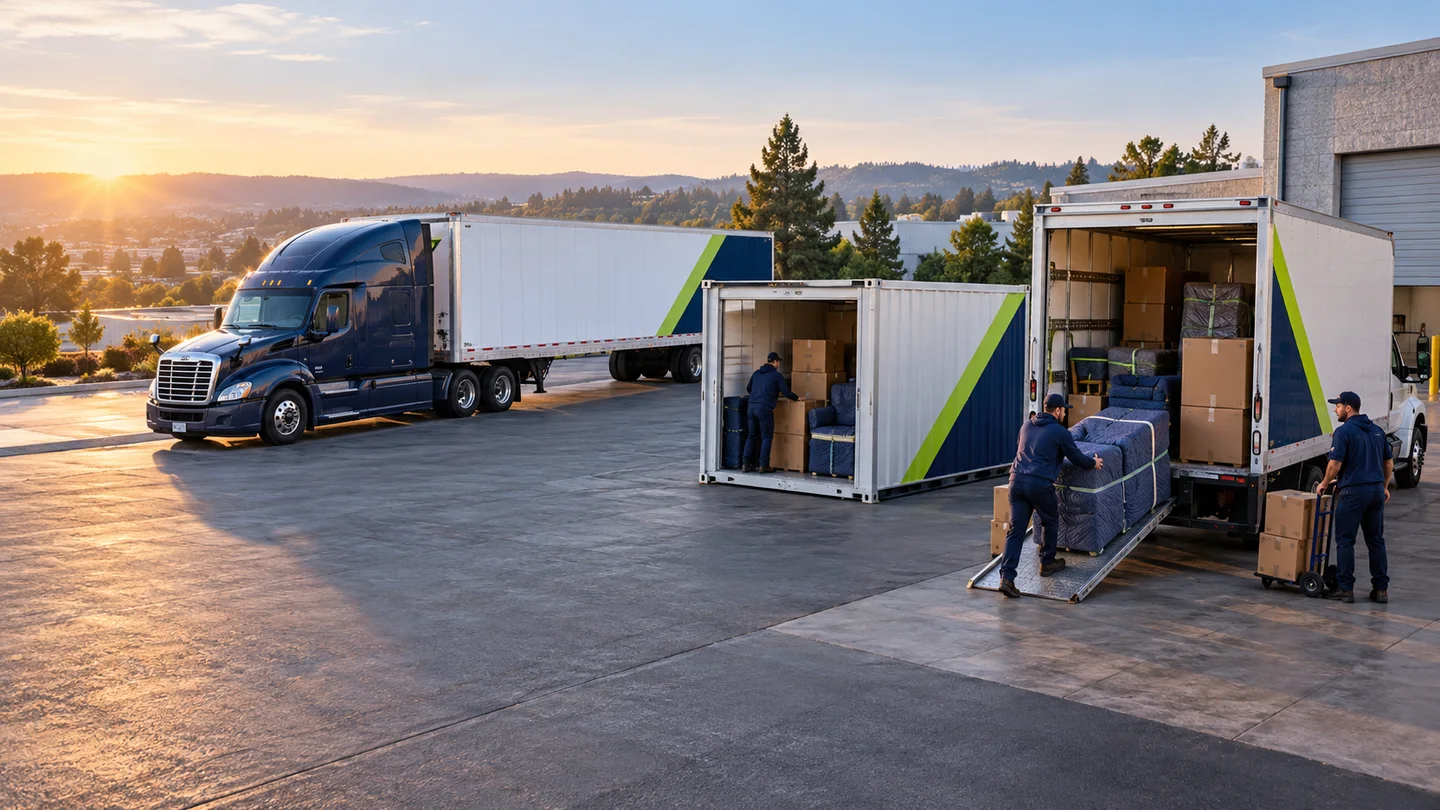
A cross-country move is easy to describe as a trip from one address to another. The shipment itself may make a more complicated journey. It might stay in one moving van, share space with other households, travel in a portable container, or occupy a section of a freight trailer. Each arrangement changes who loads it, how often it is handled, where it waits, and which documents identify it at delivery. Those details matter more than a photograph of a truck or a single advertised transit time.
Start with the work you can realistically do. If you need a crew to inventory, wrap, load, transport, and unload the goods, ask for a full-service moving proposal. If you can load and unload safely, a customer-loaded container or trailer may fit. If you are comparing prices, keep the scope identical: a quote that includes loading labor cannot be compared directly with one that supplies only space and transportation. The useful question is not “Which truck is cheapest?” It is “Which chain of work, custody, and delivery matches my household and destination?”
Federal rules also differ by arrangement. The Federal Motor Carrier Safety Administration's definition of a household-goods motor carrier describes carriers that ordinarily offer services such as estimates, inventories, packing, and loading. It expressly excludes a carrier that transports goods in a container or trailer entirely loaded and unloaded by someone other than the carrier or its agent. This does not mean that a customer-loaded shipment has no contract or no protection. It means you should identify the actual carrier, service, and governing terms instead of assuming every household-goods rule applies in the same way. For a move wholly within one state, state and local rules may also matter.
Define the four common transport arrangements

A dedicated moving van carries one household's shipment under an exclusive-use arrangement. The equipment may still need maintenance, fueling, or a driver change, but the contract should say whether other customers' goods can be added or the shipment can be transferred. Dedicated service may help when the shipment fills much of a vehicle, access is straightforward, or a narrow delivery window matters. Do not infer exclusivity from a salesperson's phrase “your truck.” Ask for it in the written order and ask what happens if the equipment breaks down.
A consolidated moving van groups several households' shipments on a line-haul route. A carrier may assemble loads at a warehouse, use partitions or labels, and deliver them in a sequence. The route can make sense for a smaller shipment, but it introduces more questions about item identification, handling, and the delivery spread. A shared van does not automatically mean that goods will be lost or delayed. It means the proposal should explain how each household's goods are separated and tracked, whether a transfer is planned, and which documents will accompany the shipment.
A portable container is delivered or made available for loading, then picked up and moved through a network. The container itself can be a useful physical unit of custody if the company documents its ID and seal. Some services keep the same loaded container through most of the trip; others may move it between vehicles, yards, or storage locations. The household may hire separate loading labor, but that changes who is responsible for the load and what the carrier's contract covers. Do not assume that “container” means door-to-door without terminal handling, storage, or a final truck leg.
A customer-loaded freight trailer usually gives the household a measured portion of trailer space. The carrier transports the loaded trailer, and the customer or separately hired labor handles loading and unloading. The space may be separated from other freight by a bulkhead or another system specified in the agreement. Confirm the loading height, ramp, equipment, access period, measurement method, weight rules, and whether anyone will open or rehandle the load. The carrier's written terms, not a generic description of freight service, govern the actual arrangement.
Compare the work, not the headline price
Build a one-page scope table before accepting any quote. Put pickup labor, packing materials, protective wrapping, loading equipment, transportation, fuel or mileage charges, terminal or yard handling, storage, delivery appointment, unloading labor, stairs, shuttle access, and valuation or cargo protection on separate lines. Mark each line “included,” “optional with price,” “customer supplies,” or “not offered.” A blank cell is a question, not a saving. If two proposals use different units—weight, container, trailer feet, or a fixed shipment price—note the basis before comparing totals.
The FMCSA pickup guidance says that an interstate household-goods mover may require a bill of lading that is incomplete only for information that cannot yet be known, such as actual shipment weight and related final charges. It also says the driver must give the customer a copy before or at loading. That guidance is for the regulated moving arrangement it describes; it is not a template to impose on every customer-loaded trailer. The general purchasing lesson still holds: obtain a complete written description of the service you are buying, and do not let an unknown final measurement become an unexplained charge.
Suppose one proposal is $4,800 for a crew-loaded move and another is $2,700 for transportation in a customer-loaded trailer. The second number is not necessarily the lower all-in cost. Add loading and unloading help if needed, a place to keep the trailer during loading, supplies, fuel for your own travel, and any delivery or access charges. Conversely, a household with capable help, simple access, and flexible dates may value paying only for transport. The calculation is specific to the shipment. Avoid a universal “best” method based on a sample quote.
Count the handoffs and name the custodian
Draw the shipment's path as a sequence of custody points: origin residence, loading crew, origin vehicle, local yard, line-haul equipment, destination yard, final-mile vehicle, and receiving household. Not every service uses every point. For each one that does, ask who controls the goods, whether the container or load is opened, how the company records the transfer, and who can answer a location question. A tracking page may show “in transit” while the practical issue is whether the goods are still in the same sealed unit.
A dedicated van with one driver may have fewer routine physical handoffs, but a vehicle failure can still force a transfer. A consolidated load may be intentionally handled at a warehouse. A container may change chassis or truck without the contents being touched. These are different events. Ask the company to distinguish movement of a sealed unit from unloading individual goods. Record container, trailer, seal, and shipment numbers alongside the names and dates. The container handoff guide gives a more detailed record to request when that method is offered.
If a company says it cannot tell you whether the goods will be transferred, ask what its contract permits and what notice it gives after a transfer. Some uncertainty is inherent in transportation. A useful answer describes the process and the record, rather than promising that every possible disruption is impossible. Before pickup, make sure you have a contact for dispatch or shipment tracing, not only a sales representative who disappears after booking.
Match the equipment to both addresses
The line-haul vehicle may not be the vehicle that reaches the door. Narrow streets, bridges, low trees, steep driveways, parking restrictions, or a building's loading-dock rules can require a smaller shuttle truck. FMCSA describes shuttle service as a smaller vehicle used where the normal line-haul equipment cannot reach a residence. Ask the provider to inspect or evaluate both addresses early and state who decides whether a shuttle is needed, what extra handling it causes, and how it is priced. The same question applies to a container that cannot be placed close to the door.
Customer-loaded equipment has additional practical constraints. Where will the trailer or container sit? Is the surface level and strong enough for the provider's equipment? How long may it remain there? Can the pickup truck reach it after nearby cars are parked? Does the property manager or municipality require permission? Ask the provider for its written placement specifications rather than relying on a rough measurement from a marketing page. The placement and pickup-access guide covers those checks in detail. A failed pickup can change the delivery plan before the cross-country leg even begins.
Make the destination equally concrete. An apartment building may allow unloading only during a reserved elevator window. A rural address may have a long private road or a bridge with a posted limit. A freight service may deliver only to an accessible curb or terminal. A moving van may include room delivery and reassembly, or charge separately. Write down the exact delivery point and who moves the goods from that point into the home. “Door-to-door” can mean different things unless the contract defines the doors and the labor.
Treat dates as a chain, not one arrival promise
Ask for four times or periods: equipment or crew arrival at origin, completed pickup, line-haul departure or acceptance, and the delivery window. A container company may offer a local pickup slot and a separate cross-country transit estimate. A freight carrier may not schedule final delivery until the trailer reaches the destination terminal. A full-service mover may offer an agreed pickup and delivery period. Write these as separate events. A quote that states “five to seven days” without saying whether the clock starts at loading, pickup, departure, or terminal acceptance is incomplete for household planning.
FMCSA's transportation guidance for regulated interstate movers describes reasonable dispatch and the mover's duty to notify the shipper if it cannot perform within the dates or periods in the order for service. It also distinguishes guaranteed delivery arrangements. Read the actual contract to know whether your service has a guaranteed date, a delivery spread, or only an estimate. Do not assume that a faster advertised route creates a guaranteed appointment. If the destination is not ready, find out when storage begins, who authorizes it, and who pays for another delivery attempt.
A household that must start work on Monday may need a few days of essentials regardless of the promised truck date. Those essentials should travel with the people, not in a container they cannot open during transit. Where possible, arrange access to the new residence before the earliest plausible delivery date. If the service permits early arrival, ask what happens if you cannot accept it. A schedule works only when the household and carrier can perform their parts on the same day.
Decide what record will identify the shipment
For a full-service interstate move, keep the estimate, order for service, bill of lading, and inventory together. FMCSA calls the bill of lading the transportation contract and says a copy accompanies the shipment while the mover or its agents possess it. The inventory identifies goods and their condition. For a customer-loaded container or trailer, ask what documents play the equivalent practical roles: booking confirmation, equipment receipt, container number, seal number, measured space, pickup receipt, terminal release, and delivery receipt. Names vary by provider, so focus on the facts the documents preserve.
At origin, note the equipment's exterior condition and identifying number before loading. Photograph the loaded interior before a door is closed, within the provider's rules. If a seal is used, record its number and who applied it. Keep a copy of the pickup confirmation and the name of the person or company taking custody. At destination, compare the unit and seal numbers before opening. If a number differs, ask for the transfer record and photograph the condition before unloading. Do not assume that a seal proves the condition of every item inside; it is one custody signal.
A single spreadsheet or folder can hold these records. Use filenames with the date and stage, such as 2026-11-02_origin-container-AB123_seal-4587.jpg. Give a trusted household member access to the essential IDs and dispatch contact in case you are traveling when the carrier calls. A shipment number that exists only in one person's email is a fragile tracking system. Keep the records until delivery, final charges, and any open issue have been resolved.
Compare protection terms by arrangement
For regulated interstate household-goods movers, federal rules require the mover to offer valuation options. FMCSA's liability and protection explanation describes Full Value Protection and Released Value. Those terms are specific to that regulated arrangement. A customer-loaded container, freight trailer, or separately hired labor company may present different contract limits, exclusions, or insurance products. Do not ask only “Are you insured?” Ask what happens if goods are damaged during loading, road transport, a terminal transfer, storage, and unloading, and identify which party handles each stage.
Read exclusions for customer-packed goods, fragile items, electronics, high-value articles, and water or weather exposure. Ask how the provider values a total loss, what documentation a claim requires, and whether a separately purchased policy covers the work of third-party loaders. Do not presume that a household policy follows goods through all transport stages. Contact the insurer for the actual policy language if that coverage is material. The decision is less about buying the largest-sounding number and more about avoiding a gap between the people who touch the goods and the party that accepts responsibility.
Take a few high-value or irreplaceable items with you when practical. A better valuation term cannot recreate original documents, medication, keys, or a family photograph. Some items may be prohibited from the shipment entirely. Ask the transport provider for its restricted-items list and follow it, especially for fuels, chemicals, and batteries. Do not put prohibited goods in a sealed container because the carrier is unlikely to inspect it. The household is still responsible for declaring and removing items the contract forbids.
Use a decision test for a real household
Imagine a two-bedroom household moving from Virginia to Colorado. The origin has a driveway with room for a container, but the destination is a downtown apartment with a loading dock available only on weekdays. The household can hire loading help at origin, but it cannot take a week off to wait for an uncertain final delivery. A portable container could work if the provider confirms placement, terminal handling, storage, and a scheduled final-mile appointment. A dedicated full-service truck might reduce the coordination work if a written delivery commitment fits the building window. A shared truck could be economical if the household can accept a broader spread and arrange temporary lodging. The method cannot be selected honestly from price alone.
Now change one fact: the new building bans container drop-off and freight trailers. The container and trailer options may still be possible with terminal pickup or a separately priced local truck, but they no longer offer a simple door-to-door path. Change another fact: the household has a non-running vehicle to ship. That is a separate transport problem with its own equipment and condition report; bundling it with the household quote does not eliminate the need for separate dates and records. A quote should reflect the actual path, not a generic route between two ZIP codes.
Before booking, ask each provider to answer the same six questions in writing: Who loads and unloads? What equipment or space is reserved? How many custody handoffs are planned, and will the goods be opened or rehandled? What dates are commitments and what dates are estimates? Where exactly will delivery occur? Which contract protects the goods at every stage? Add the all-in cost after those answers are clear. If a provider cannot answer a question yet, record the condition that must be met before the booking becomes final.
The strongest choice is the one whose labor, equipment, access, timeline, custody records, and protection terms work together. A dedicated van, shared van, container, or freight trailer can each fit the right move. The household's job is to make the transport leg visible before the goods leave the driveway, then keep enough evidence to recognize the same shipment when it reaches the other end.
Check the current rule, contract and source page for your route and service. This guide helps you prepare clear questions and records.