

A portable container is useful only if the delivery driver can set it down, the household can load it safely, and a pickup truck can return to remove it. The most common planning mistake is measuring the rectangle where the container will sit and stopping there. A truck needs an approach, clearance to maneuver, and a departure path. People need room to open doors and carry furniture. A city, property manager, or homeowners association may control whether the unit can stay in that location at all. Those constraints can turn a seemingly inexpensive transport quote into a delayed pickup, an extra trip, or a terminal-loading arrangement.
Treat placement as a transport operation, not a storage preference. Ask the provider for the exact outside dimensions of the unit it will deliver, its required overhead and side clearances, the size and turning requirements of its delivery vehicle, the surface and slope limits, and the direction the doors will face. Do not use a competitor's generic diagram as the rule for your provider's equipment. Send photographs and a simple measured sketch of the proposed location. Have the provider confirm the placement in writing before you schedule loading labor or a building elevator.
The rules also differ by location. A container entirely on private property may be subject to lease, building, or association rules. A unit in a public street or parking lane may need municipal permission or may be prohibited. Seattle's residential container permit guidance says portable moving and storage containers in the public right-of-way require a Street Use permit. New York City's 311 guidance says storage containers used for non-construction personal-goods storage are not permitted on city streets. These are examples, not a national rule. Check the current authority for both addresses.
Measure the full operating footprint
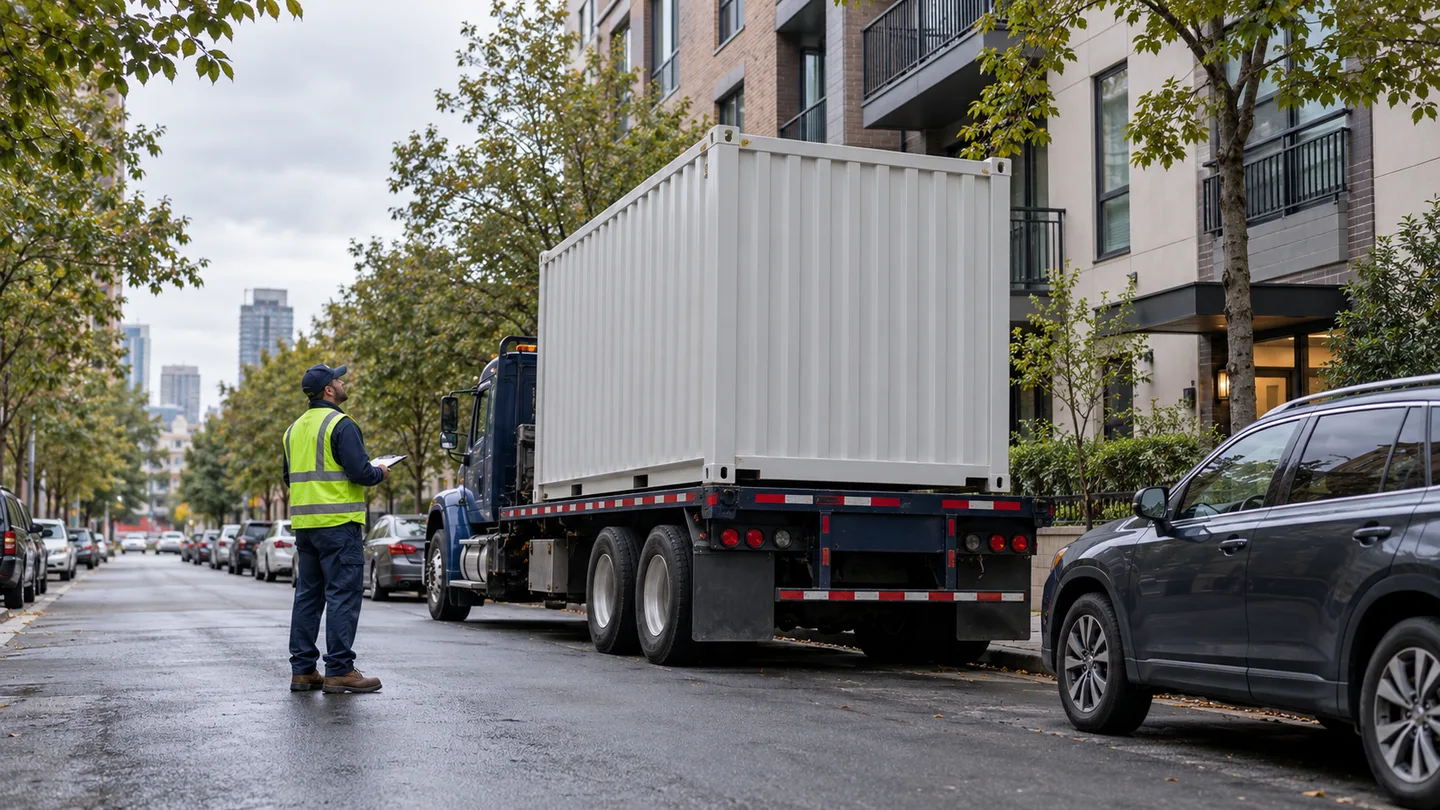
Draw the container as a rectangle, then add the provider's specified buffer around it. Mark the doors, the planned loading path from the home, and the truck's approach. The container length and width alone do not tell you whether a driver can place it. A delivery vehicle may need to align straight with the spot or leave room for a lift system. Some equipment can set a unit in a narrow driveway; other equipment cannot. Ask the provider whether the doors can face the house as you expect and whether a wall, fence, or garage door will block them once the unit is on the ground.
Measure the narrowest points, not only the broadest section. Gateposts, mailboxes, parked cars, retaining walls, stairs, air-conditioning units, and landscaping can reduce usable width. A driveway that is wide at the street may narrow near the garage. A loading path that seems open when empty may disappear when the container doors swing out. If furniture must pass through a side door or around a corner, test its actual dimensions before reserving the unit. The guide to estimating usable container space helps separate the container's advertised size from a workable furniture arrangement.
Check overhead space in every part of the truck route and placement area. Trees, power or communication lines, eaves, awnings, balconies, and building signs can interfere with a lift. Do not touch or attempt to move a utility line yourself. If a branch or structure is in the provider's stated clearance envelope, ask the provider for another placement or use a properly authorized professional to assess the obstruction. A photo taken from the street at truck height can make the issue easier to discuss than a measurement alone.
Check the surface and drainage
Ask the provider what surfaces it permits. A paved driveway may be easier to evaluate than soft ground, but pavement can still be sloped, cracked, or weak near an edge. Grass, gravel, pavers, and asphalt may have different load or damage concerns. The container becomes heavier as it is loaded, and the delivery truck may put additional weight on the approach. Do not guess a safe ground-bearing capacity from a photograph. If the spot is questionable, ask the provider to inspect it or decline the placement. The company should explain whether it supplies protective boards, leveling methods, or another option under its own procedures.
Look at water flow. A low spot that collects rain can make loading slippery and expose the bottom of the container to water. A unit that blocks a drain can cause a problem for the household or neighbors. Check the route from the home during the weather you may actually face, not only on a dry morning. If snow, ice, or mud is possible, ask whether the provider will attempt pickup under those conditions and what the household must clear. Keep people away from the truck's operating area when the unit is being set down or lifted.
Photograph the surface before placement and after removal. This is a practical property record, not an accusation. Note existing cracks, stains, or damaged edging so any later discussion starts with facts. If a lease or association requires a damage deposit for a container, keep the inspection record with that agreement. Ask whether the provider's terms cover damage caused by its equipment, by the loaded container resting on the surface, or neither. The answer may vary by company and location.
Resolve permission before the truck arrives
Private property does not always mean unilateral permission. A renter may need written landlord consent. A condominium may require an approved location, insurance certificate, elevator reservation, or time limit. A subdivision may have rules against visible storage units. Ask the controlling party what type of permission is needed and how long approval takes. Send the provider's equipment dimensions rather than saying only “a moving pod.” An approval for a moving van to park for two hours may not cover a container sitting for several days.
For public property, identify the exact authority. A city transportation department may handle the curb lane, while a property manager controls a private garage or loading bay. Permit requirements can depend on street class, length of stay, neighborhood, parking restrictions, and whether pedestrians or cyclists are affected. Seattle's guidance describes placement in legal parking spaces and asks applicants for a right-of-way impact plan. New York City's restriction shows why a general statement that “a permit can always be obtained” would be wrong. If you cannot get a clear answer from the provider, contact the local permitting office through its official website.
Do not wait until the day before delivery to learn that a permit requires lead time or a street-use drawing. Ask who applies, who pays, who posts any temporary no-parking signs, and who is responsible for compliance if the unit remains longer than planned. Keep a copy of the issued permit or written authorization. If permission is denied, decide whether the unit can be placed on private land, loaded at a terminal, or replaced with another transport method. The choice may change loading labor, transportation charges, and delivery timing.
Walk the truck approach and exit
Stand where the driver will enter the street or driveway and follow the likely path. Mark tight turns, one-way streets, low bridges, weight postings, blind corners, steep grades, and gates. Do the same at the destination. A navigation app route for a passenger car is not proof that a loaded delivery vehicle can use it. The provider is responsible for its equipment decisions, but the household can disclose constraints before dispatch. Ask what vehicle it normally uses for this address and whether its driver can review photos or perform a site check.
Parking is dynamic. A clear curb in an old photograph may be full on pickup day. If the provider needs a clear lane or driveway, arrange a lawful way to keep it available. Do not place cones on public streets unless local rules allow them. Record the appointment window and the driver's expected call-ahead. If a neighbor's vehicle blocks the approach, have a contact plan before the truck arrives. Keep a second approved placement only if the provider says it can use it safely. Improvised repositioning can put the doors against a wall or shift the container onto property that has not been approved.
FMCSA's general moving definitions describe shuttle service when a normal line-haul vehicle cannot reach a residence. That specific consumer rule applies to the regulated mover arrangement, but the access lesson also matters for containers: if the planned vehicle cannot reach the address, the goods may need another vehicle or terminal handling. Ask whether the provider's container can be transported on a smaller truck, whether the unit itself stays closed, and what charge or delay follows. The customer-loaded trailer plan is a different service and should not be treated as an automatic fallback without checking equipment and labor.
Arrange the loading path as carefully as the vehicle path
The safest placement for the truck may not be the easiest placement for people carrying furniture. Measure the distance from the door to the container, the number of steps, the width of gates and hallways, and the height of the container threshold. Ask the provider what ramp or loading aid it supplies, if any. Do not assume the delivery driver will move household goods; a customer-loaded service may supply only equipment and transportation. If separate labor is hired, confirm it can work at the selected spot and that it knows the loading window.
Leave space for doors to open fully and for people to step back while carrying a large object. Avoid a route across a public sidewalk that pedestrians must use unless a permitted arrangement addresses it. Keep children and pets away from the active loading area. If the container is on a driveway that also serves neighbors, coordinate access before blocking it. A loading plan should not depend on every trip being completed through a narrow gap beside a parked car.
Take an inventory of the items that cannot pass the path as configured. A sofa may fit inside the container but not around the porch turn. A treadmill may need disassembly under its manufacturer's instructions. If a heavy object requires specialist handling, decide that before the unit arrives. The provider may prohibit certain items or require special bracing. Follow its written loading guidance and any applicable safety instructions instead of relying on a generic online packing illustration.
Protect the pickup appointment
Placement is only half the job. Before the final loading day, ask what must be true for pickup: doors closed, lock or seal applied, unit weight within the contract limit, access clear, permit still valid, and a responsible adult available if required. Confirm whether the provider can take a partly loaded container or whether a load must be secured first. Photograph the closed unit and its number after loading. Capture the receipt and seal details when the driver takes it.
Recheck the approach the night before pickup. A temporary construction barrier, parked delivery van, fallen branch, or new puddle can alter access. If a problem appears, contact the provider before the dispatch window so it can advise or reschedule safely. Do not ask a driver to work around a clearance it has said is unsafe. A missed pickup may extend container rent or disrupt a downstream line-haul reservation; ask the provider how those changes are handled and document the revised dates.
At the destination, do the same review before final delivery. A new building's loading dock may be reserved only during certain hours. A street permit may expire before a delayed truck arrives. The household may need keys or access credentials to open a gate. Confirm who will unload, how much time is allowed, and where an empty unit may remain until the provider retrieves it. Final pickup of the empty unit is another appointment and another property-access event.
Build a placement schedule that survives a delay
Work backward from the promised pickup rather than assuming the container can sit indefinitely. Write down the authorized placement start and end, the planned delivery appointment, the first day labor can load, the provider's pickup window, and any extra-rent threshold. Compare those dates with the actual move-out deadline. A household that receives a unit on Friday but cannot load until Monday may be using most of its allowed curb time before the first box goes in. At the destination, a delayed line-haul can create the opposite problem: a permit or dock reservation may end before the unit arrives.
Ask the provider how it handles a date change at each stage. Can the placement appointment be moved without losing the unit? How much notice is needed to shift pickup? Does the container wait at a local yard, and is that storage included? What happens if the driver arrives but a locked gate prevents access? A price list may separate an attempted delivery from a daily storage charge. Read the written terms and request a revised estimate if the contingency could materially change the cost. Do not accept a vague promise that the driver will simply return when convenient.
Give one household member responsibility for the access record. That person keeps the placement approval, provider confirmation, gate code instructions, building contact, permit dates, and photographs together. Share only the access information the driver needs through the provider's approved channel. If a building requires an insurance certificate or a loading-dock reservation, verify receipt before dispatch; an emailed request is not the same as an approved reservation. If the provider calls before arrival, the contact should be able to answer quickly and describe the exact location without asking the driver to improvise.
Set a decision point before loading begins. If the container has not been placed by then, determine whether to move the labor reservation, use a provider-approved terminal loading option, or change the shipment method. This prevents paid helpers from arriving at an empty driveway and keeps the household from piling goods in a public path. At the destination, set a similar decision point for unloading labor and building access. The schedule should identify who can authorize a change and how the new date will be confirmed in writing.
If the delivery or pickup is rescheduled, repeat the access check instead of assuming the old approval still applies. Street parking restrictions can differ by weekday. A building may permit a container on a loading pad for one window only. A rainstorm may soften a lawn that looked firm during the initial review. A contractor's temporary fence can remove the truck's turning space. Send the provider updated photographs and obtain confirmation of the revised location and time. Keep the old and new confirmations together so a billing or access question can be traced to the correct appointment. These small checks are especially valuable when the origin and destination are managed by different people who have never spoken with one another.
Make a two-address decision
A household moving from a suburban driveway to another suburban driveway might place a container at each home if both sites meet the provider's equipment rules. A move from that driveway to a dense city apartment could require terminal pickup, a smaller final-mile vehicle, or a different method entirely. The origin convenience does not settle the destination problem. Ask for a written description of the final handoff and all charges before choosing the container service.
Use a simple go/no-go record for each address: provider equipment fits; surface accepted; overhead clear; doors and loading path usable; legal placement confirmed; truck approach and pickup path confirmed; time window approved; backup plan written. If any line is unresolved, say exactly what evidence will close it. A provider may approve a location after reviewing photographs, or a property manager may name an alternate spot. Keep that decision with the booking.
A good placement plan is visible on the ground. It shows where the unit will sit, how people will load it, how a truck will collect it, and who authorized it to remain there. That practical clarity prevents a costly transport problem before the shipment has moved a mile.
Check the current rule, contract and source page for your route and service. This guide helps you prepare clear questions and records.