

Shipping a car while moving a household creates two transportation plans. The furniture may go in a moving van or portable container, while the car travels on a multi-vehicle carrier. They can have different brokers, motor carriers, pickup windows, routes, contracts, and delivery contacts. Booking them on the same day or through one website does not make them one shipment. The household needs a plan for each vehicle and a way to bridge the days when one arrives before the other.
Start with the practical question: when will you stop using the car at origin, and when will you need transportation at destination? Work backward from those dates. A moving truck's delivery spread is not necessarily synchronized with an auto carrier's pickup and delivery estimates. Arrange a local ride, rental car, transit option, or trusted person if the car leaves before your flight or arrives after you. Keep keys, medications, documents, and essential luggage out of the shipped vehicle.
The Federal Motor Carrier Safety Administration (FMCSA) distinguishes auto transporters from auto brokers. A broker arranges the vehicle shipment; a transporter physically moves the car. Both interstate auto brokers and carriers must be registered. Check the actual carrier when assigned, not only the sales brand. A household-goods carrier may be a different business entirely, and its bill of lading does not automatically govern the car's inspection or claim.
Decide whether shipping solves the travel problem
Before booking an auto carrier, compare shipping with driving the car yourself. Add fuel, lodging, meals, time away from work, miles added to the vehicle, and the feasibility of driving with children, pets, or a second household vehicle. Shipping may be valuable when the household must fly or when driving would require several difficult days. Driving may be simpler when the car is needed immediately at destination and the trip is manageable. Use actual route and schedule constraints; a low shipping quote is less attractive if it forces a long rental-car period. For a leased vehicle, check mileage limits and any contract requirement about who may transport or receive it before choosing a plan.
Do not treat the car as a substitute moving container. A carrier may restrict or prohibit personal property inside it, and loose contents complicate weight, inspection, and loss responsibility. If you drive, you can carry essentials in the vehicle under your control. If you ship, arrange luggage or a separate checked-bag plan. That difference can shape the decision more than the headline transport price.
Set two timelines on one calendar
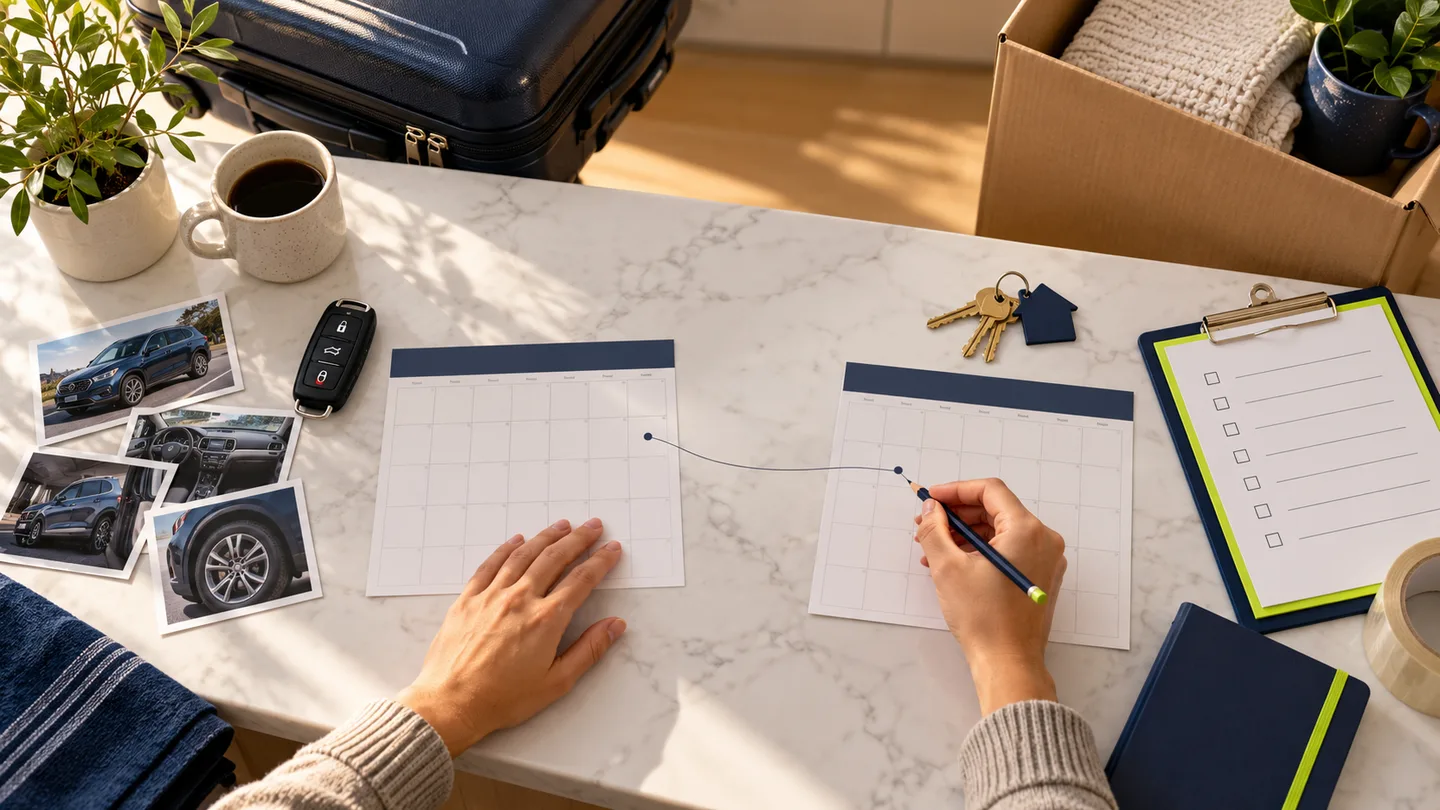
Put the household pickup, household delivery spread, car pickup window, car delivery estimate, travel dates, and access to the new home on one calendar. Add the earliest and latest dates you can release or receive each shipment. If an apartment lease ends Friday, do not plan to hand over the car at an address you can no longer enter on Saturday. If the new home cannot accept a moving truck until Monday, the car may still be deliverable nearby earlier, but someone must be available with a safe place to park it.
Ask both providers which dates are contractual and which are estimates. For covered interstate household-goods moves, FMCSA's pickup guidance says the order and bill of lading should record definite pickup and delivery dates or periods. Auto-shipping contracts may use estimated pickup and delivery windows under their own terms. Do not transfer the household mover's delivery promise onto the car carrier. Write the two commitments separately and keep screenshots or signed documents showing any revisions.
A few days of schedule overlap can be useful, but it is not free. Consider the cost of a rental car, parking at either end, and someone else's time to accept delivery. Avoid setting a narrow auto pickup window that conflicts with the only day you can supervise the moving crew. If the car carrier must collect from another location, confirm the address and authorized handoff person before dispatch. The driver may have a large rig that cannot enter a narrow residential street.
Decide who will receive each shipment
The furniture receiver and car receiver can be different people. Give the household-goods receiver the item inventory, building access instructions, and payment terms. Give the car receiver the vehicle VIN or other identifier, pickup condition report, carrier contact, delivery location, keys arrangement, and inspection instructions. Do not assume one person has the time or authority to handle both. A friend who can sign for boxes may not be comfortable inspecting a vehicle in poor light.
Ask the auto provider whether a designated agent may sign at pickup and delivery and what identification it requires. Montway's published terms describe its process for a customer or agent to inspect and acknowledge vehicle condition. Other companies can differ. The receiver should know how to note new damage before signing, request a copy of the condition report, and contact the carrier's office if the driver is early or late. Give them enough time and daylight to inspect the car.
For the household shipment, the receiving person needs the moving inventory and the current delivery period. FMCSA's pickup guidance addresses the bill of lading and inventory for covered interstate moves. If the furniture will arrive in two vehicles, tell the receiver which pieces belong to each. The two receivers can share a calendar, but they should not merge the paperwork; a vehicle's preexisting scratch has no relationship to the household item inventory.
Choose the auto service for the actual car
Give the auto provider the year, make, model, trim or dimensions when relevant, running condition, ground clearance, modifications, and pickup and delivery ZIPs. A low sports car, roof rack, oversized tires, or non-running vehicle may need different equipment or a special loading method. Ask whether the quote assumes open or enclosed transport, door-to-door service where legal, or a terminal handoff. The open and enclosed transport guide explains the tradeoffs in exposure, loading, availability, and price.
Do not choose enclosed transport solely because the furniture move is expensive, or open transport solely because it is common. The car's condition, value, modifications, and tolerance for road exposure matter. Ask for the carrier's cargo coverage terms and claim process under the actual auto booking. A moving company's household valuation option does not describe coverage for a separately shipped car. Keep any added coverage documents with the auto contract rather than the furniture quote.
If the car is not operational, disclose that before pricing. The carrier must plan for loading and unloading without driving it normally. The guide to preparing a running or inoperable vehicle covers keys, brakes, steering, rolling condition, and equipment questions. A vehicle that starts inconsistently should be described honestly; calling it “running” to obtain a lower quote can lead to a failed pickup or an extra charge when the driver arrives.
Compare the two providers' access needs
A large auto carrier may not be able to stop at the same door where a household moving truck loads. Ask the driver or dispatch for a lawful meeting point with room to load, inspect, and turn. A shopping-center lot is not automatically available for commercial loading; get permission where required. Do not wait in an unsafe shoulder or block a residential intersection. Confirm the exact location and the person who will bring the car there.
At destination, check the same constraints. If the household has moved into a high-rise, the auto transporter may need a nearby lot rather than the building dock. A driver can deliver a car to a permitted location while the moving crew uses a reserved freight elevator. Coordinate times so the receiver can attend both without leaving a truck waiting. If separate people handle the events, share the current schedule and phone numbers with each, but keep personal access codes limited to those who need them.
Some providers use terminal-to-terminal service. Ask how the car gets to the origin terminal, when it becomes available at destination, whether storage fees begin after an arrival notice, and what identification is needed to release it. This differs from a residential vehicle handoff. A terminal may have limited hours that conflict with travel or the furniture delivery. Put those hours on the shared calendar before accepting a lower terminal quote.
Prepare the car before moving day
Clean the exterior enough to see existing scratches and dents, take dated photographs from every side, and record odometer and visible condition. Walk the car with the driver at pickup and compare the vehicle condition report before signing. Montway's vehicle-preparation guide describes its use of a bill of lading to record condition at pickup and delivery. Use the actual carrier's form and read its instructions. Photographs help, but they do not replace the signed condition record.
Remove toll tags, parking passes, removable exterior accessories, and valuables. Follow the carrier's specific rules for fuel, battery charge, personal items, alarms, and keys. A provider's allowance for one small item in the trunk is not a general license to pack the car with household boxes. Loose contents can shift, affect loading, or fall outside the carrier's cargo terms. Keep medicines, identity papers, cash, and irreplaceable items with you rather than in either shipment.
Confirm the car's running status close to pickup. If a battery has failed or a tire is flat, tell dispatch before the truck arrives. The driver may need a winch or different carrier configuration. A vehicle that can be driven around the block may still be too low for a standard ramp or have a brake issue. Ask the provider which conditions count as inoperable under its quote. Do not ask a driver to improvise an unsafe load to preserve the original price.
Keep payments and credentials separate
A bundle quote can conceal two business relationships. Ask for a written price for the household move and a written price for the car shipment, with each company's legal name, services, deposits, remaining balance, payment method, and cancellation terms. If a broker takes a fee and the carrier collects the remainder, the documents should say so. Do not assume a deposit paid to one company covers delivery charges to the other.
FMCSA's auto-transport advisory tells consumers to check carrier or broker registration and monitor authorized card charges. Confirm a changed payment instruction through the published business contact, not only an unexpected text. Ask which entity issues the receipt and handles a billing dispute. The household mover's freight bill and the car carrier's bill should be retained separately even if one site generated both leads.
Keep the auto booking ID, carrier MC or USDOT identifiers, vehicle VIN reference, pickup report, and delivery contact in an auto folder. Keep the moving estimate, order, bill of lading, household inventory, valuation choice, and delivery receipt in a separate folder. A shared calendar can link the plans without mixing their legal documents. The receiving person should be able to find the right form when the driver arrives without searching through furniture receipts.
Plan for one service to arrive first
If the car arrives before you, designate an adult who can inspect it in daylight, sign accurately, and park it legally. Ask the provider whether there is a permitted delay or terminal hold and what it costs. Do not leave keys in a mailbox or ask a driver to abandon the car at a curb without a signed handoff. If the household goods arrive first, make sure the receiver has access to the home even if the car is still on the road.
If the car is late, consider how you will get to work, school, or the new home. A rental or rideshare can bridge the gap, but check cost and availability before departure. Ask the auto carrier for its latest confirmed pickup or transit event and revised estimate. The household mover's arrival does not predict the car's arrival. Likewise, a car delivery does not mean the furniture can be accepted earlier than the signed moving period.
If the furniture shipment is delayed, FMCSA's transportation guidance describes delay notice duties for covered interstate household-goods carriers. That process does not automatically apply to a separate auto shipment. Contact each provider about its own revised dates and keep each notice. Label a temporary change to your travel plans so that the car carrier does not attempt delivery to an address where no one is available.
Confirm dispatch without tying up the driver
Ask each provider when it will contact you before pickup and delivery, and what number or email will be used. A carrier may provide a broad date range at booking and a narrower appointment after dispatch assigns a truck. Keep the official business contact and the assigned driver’s number, but use the office for contract and payment questions. Drivers may be loading, driving, or resting and cannot always answer a call. A missed call from the driver should not force the household to accept an unverified new payment request.
When an appointment is set, repeat the exact address, gate or meeting-point directions, contact person, vehicle description, and safe parking place. Do this separately for the household truck and auto carrier. If one pickup changes, update the shared calendar immediately and tell the person responsible for the other handoff only if the conflict affects them. Keep a record of the confirmed times and who supplied them. A single coordination sheet is useful; a single combined contract is not required to make two carriers work together.
Inspect the car at the final handoff
The receiver should compare the car's exterior, glass, wheels, underside where visible, and interior with pickup photos and the condition report. Check odometer and whether the vehicle starts and moves normally if it was tendered as running. Inspect in adequate light before signing. Note any new damage on the delivery report, request a copy, and photograph the condition. If the driver offers only an electronic signature, read what the screen says and get a copy or confirmation.
If damage is found, notify the auto carrier under its claim procedure promptly. Preserve pickup and delivery reports, photographs, communications, and repair estimates as requested. Do not claim that every new mark was caused in transport without comparing the pickup record. If the car is not present at the stated location, use the carrier's official dispatch number and booking ID to establish the last physical handoff. A furniture mover's customer service line may not have that information.
At the end, reconcile the two services independently: household inventory and bill paid, car condition and auto bill paid, keys returned, and any open claim documented. The move works best when the household coordinates dates and people while allowing each carrier's contract and custody chain to remain clear. One calendar can manage both, but one vague “moving status” cannot verify two separate shipments.
Check the current rule, contract and source page for your route and service. This guide helps you prepare clear questions and records.