
A delayed household shipment creates two separate problems: the goods may be somewhere other than expected, and the people waiting at pickup or delivery may not know what to do next. A useful update must solve both. It should tell you what part of the move is interrupted, what the carrier has confirmed, which date or time window is changing, and who will contact you again. “The truck is running late” is not enough to plan a hotel, keep a helper on standby, or decide whether a destination appointment still works.
Interstate household-goods carriers are expected to provide reasonable dispatch service unless the shipment is covered by a guaranteed delivery date with terms that govern the situation. The Federal Motor Carrier Safety Administration explains that when a mover becomes unable to meet the pickup or delivery dates or periods in the order for service, it must notify the customer at its expense as soon as the delay becomes apparent and advise what alternative dates may be available. Read the order, bill of lading, and any written updates together; the exact service dates and agreed periods matter. This guide offers a practical way to request clear updates, preserve the record, and coordinate a new handoff without treating an estimate as a guarantee.
Start with the agreement, not a remembered promise
Before asking dispatch to change the plan, find the most recent signed paperwork. Gather the estimate, order for service, bill of lading, inventory, written delivery spread or guaranteed-date terms, and any approved change order. Identify the pickup and delivery dates or periods shown in the documents. A phone conversation, text message, or portal status can be useful evidence of a later conversation, but it should not replace the controlling paperwork in your notes.
Write down the shipment or order number, origin and destination ZIP codes, the name of the booking company, the carrier actually transporting the goods if known, and the main contact. Keep these facts in a single note so you do not have to reconstruct them during each call. If the paperwork lists an agent, broker, or carrier, record each role separately. The person who sold the move may not be the person who controls a truck or warehouse. Ask which dispatch desk has authority to confirm the current location and revise the delivery plan.
Separate the dates into three categories: the dates originally agreed in the documents, any later dates confirmed in writing, and an unconfirmed estimate supplied during a call. Label estimates as estimates. A portal that displays a delivery date might be showing a planned appointment, a date range, or a system-generated target. Ask what the date means and whether it has been confirmed with the delivering crew. This prevents an assumed window from turning into a missed workday or an unnecessary trip to the new home.
Ask dispatch for facts you can act on
When you reach the coordinator, begin with a concise description: “I am calling about shipment number __. The current paperwork shows delivery during __. The latest update says __. Please tell me which segment is delayed, what is confirmed, and what I should plan around.” This keeps the conversation focused on the shipment rather than a general complaint. If the interruption involves a road closure, equipment issue, terminal transfer, weather, a crew schedule, or destination access, ask the representative to describe only what the company has verified.
Request the last confirmed location and the time it was confirmed. Ask whether the load is still on the same vehicle, has been transferred, is waiting at a terminal, or has been assigned to a different delivery crew. A tracking screen may not show a live GPS position; do not assume that a status code proves a truck is physically at a specific address. If the carrier cannot provide a location, ask what step is underway to verify it and when someone will call or write back.
The next useful question is what part of the service is affected. Is the pickup still possible? Is the long-haul leg moving? Are other shipments being unloaded first? Has the destination terminal received the shipment? Is the final-mile appointment the only part that changed? A load can continue moving even when the original delivery crew is unavailable. Conversely, a truck may be near the destination while the shipment is not ready for delivery because a terminal count, paperwork review, or access plan remains open. Pin down the stage before changing travel or lodging arrangements.
Ask for a revised date or date range that dispatch can support, and ask whether it is confirmed or provisional. If a specific day is unavailable, ask what alternative dates the mover can offer and whether the company needs a response from you. FMCSA's transportation guidance describes the notice and alternative-date process for a delay. A dispatch estimate may still change if conditions change; ask what event would make the new window firm, such as arrival at the destination terminal or assignment of a local crew.
Coordinate the people and access plan
Dispatch information only helps if the right people receive it. Confirm which telephone number and email address the coordinator will use, and read them back. If a spouse, relative, building manager, or authorized receiver will be at the destination, ask whether the carrier can include that person on delivery updates. Do not share someone else's contact details without permission. If the company requires an authorization or a named consignee, follow its process and keep a copy of the confirmation.
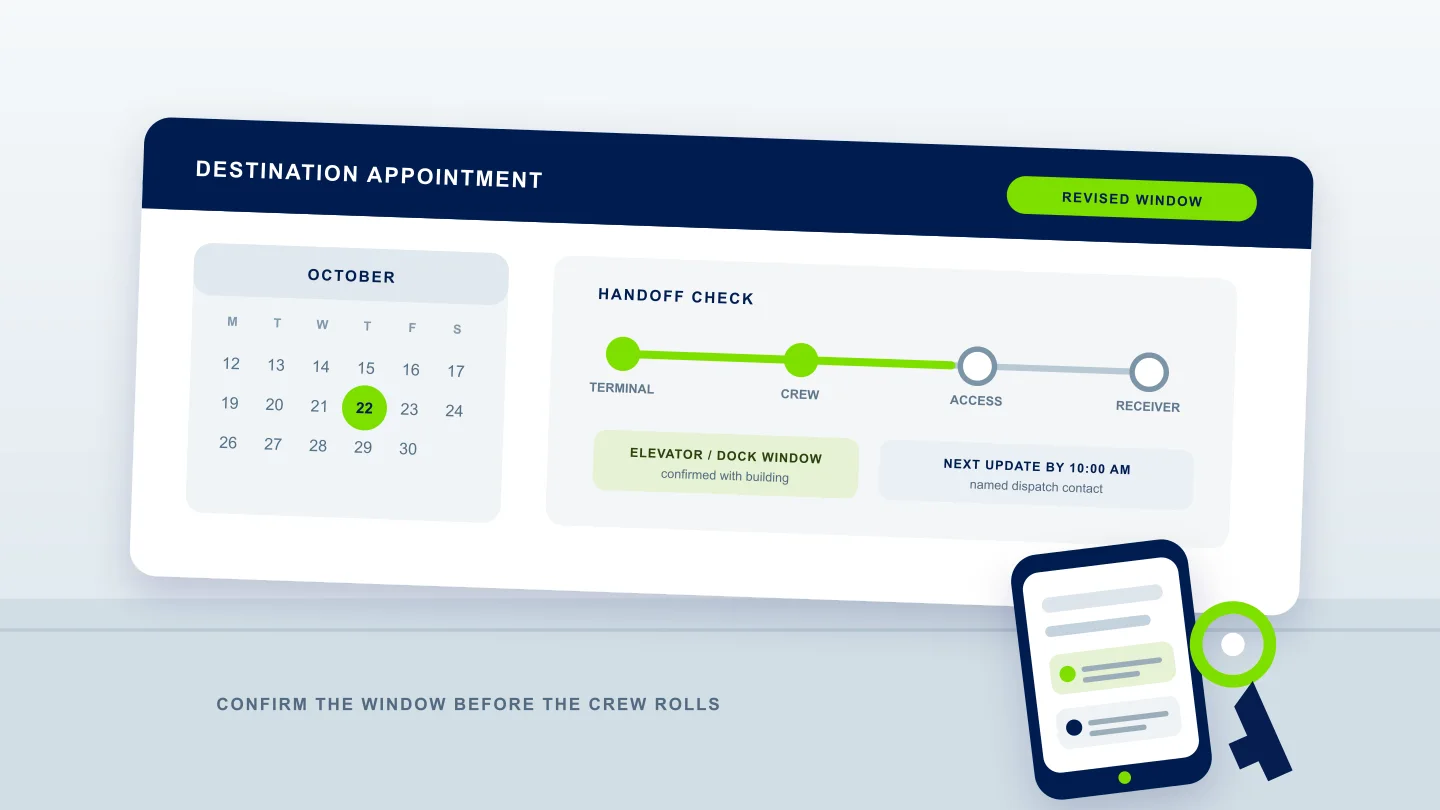
At the origin, decide whether anyone must remain available for loading, whether keys or building access need to be rescheduled, and whether temporary storage or another pickup date is being discussed. At the destination, check elevator reservations, loading-dock hours, street permits, parking, gate codes, and the availability of a person able to sign. A delayed truck can easily miss a reserved building window. Contact the building promptly to ask whether it can move the reservation, and record any new fees or deadlines. Do not assume the mover will pay a third party's cancellation fee; ask dispatch and review your contract before relying on reimbursement.
If you are traveling separately, avoid making a last-minute trip solely on an unconfirmed delivery estimate. Ask whether you can receive a call when the truck is dispatched from the destination terminal, and whether an appointment is required. If the shipment is split across vehicles, confirm which part will arrive first and whether a partial delivery is expected. Share the relevant inventory pages with the receiver and the carrier so a partial arrival is not mistaken for a complete delivery. Once dispatch confirms that the shipment has reached the destination terminal, use the guide to booking a final-mile delivery appointment after line haul to confirm the local crew, access window, and receiver before the truck is sent.
If your home is not ready, say so immediately. Do not leave the crew to discover an access problem at the curb. Ask whether the carrier can hold the shipment, whether storage-in-transit is available under its tariff, what period applies, and which charges and redelivery terms could follow. Request those terms in writing before authorizing a change. If the mover offers delivery before you can accept it, ask what storage arrangement and facility would be used, who is responsible for the charges during the hold, and what notice you will receive. Your options depend on the agreement and governing rules, so do not rely on a general promise that “the warehouse will keep it.”
Make any date change explicit
A revised appointment should not live only in someone's call notes. Ask the mover to put the new pickup or delivery dates or periods in a written update, order change, or other record that identifies your shipment. Check that the revised plan states whether the original guaranteed-date terms still apply, whether the new window replaces the prior one, and whether any additional services or charges are involved. If the representative says no paperwork is needed, send a brief email summarizing the conversation and ask the company to correct any inaccurate detail.
Read the change before accepting it. Confirm the destination, shipment number, service requested, date or spread, pickup or delivery location, and person authorized to receive the goods. If you only agreed to a different time window because the original one was unavailable, make clear which option you accepted and what remains unresolved. Do not sign a blank form or agree to “as soon as possible” when you need a usable date range. FMCSA's pickup guidance advises shippers to agree on definite pickup and delivery dates or periods and to have them entered on the order for service and bill of lading.
When you request a change, the carrier may need to coordinate equipment and other customers. Ask what alternatives are available rather than assuming the first proposed date is the only one. If your request would cause a hold or storage, compare the available choices with your lodging, lease, work, and building constraints. Ask for an itemized explanation of any new service charge and the contract or tariff provision it relies on. Keep the written response. A revised date can be operationally necessary without deciding who is responsible for every cost caused by the disruption.
Keep a dispatch log
Create one dated line for every meaningful call, text, email, or portal update. Record the local time and time zone, the contact's name or team, number or address used, the facts stated, and the next action promised. Distinguish a verified fact from a forecast. For example: “Terminal arrival confirmed at 3:20 p.m.; local truck assignment not yet made; coordinator will update by 10 a.m. tomorrow” is more useful than “shipment delayed.” If a promised callback does not arrive, the log helps the next person continue from the last known step.
After an important conversation, send a short neutral recap: “Today you confirmed __; the delivery window is now __; __ remains unconfirmed; please contact me by __ if the plan changes.” Avoid argumentative or speculative wording. The goal is to establish an accurate shared record. Save screenshots of portal statuses with the date visible when possible, and download correspondence rather than depending on a service dashboard that may later update.
Keep original documents intact. Do not write new notes over an inventory, bill of lading, or delivery receipt. If a record needs context, add a separate dated note and retain the original. Store receipts for hotels, missed appointments, temporary storage, or additional travel in a folder with the dispatch log. A receipt does not by itself establish that an expense is recoverable, but preserving it keeps the facts available if you later ask the carrier about a claim or contractual remedy.
If a promised update never arrives
If dispatch misses a callback, contact the person or team identified in the previous update and refer to the time and commitment in your log. Ask whether there is a shipment exception number or escalation contact. If you reach a call center that cannot see the operational record, ask for the dispatch office or customer-service supervisor responsible for the carrier's destination terminal. Give the shipment number and the last confirmed event rather than retelling every part of the move.
If you cannot obtain a revised plan, send a written request that states the original agreed date or period, the delay notice you received, the latest confirmed location or status, and the decisions you need to make. Ask when the carrier will provide a verified update and which contact will own the issue. If dates or counts conflict, list both versions and ask the mover to identify the current one. Do not claim that an unverified status is proof of loss; a gap in tracking can be a communication problem, a scan delay, or a real exception, and the carrier must reconcile it.
If the carrier cannot locate the shipment, use its formal tracing procedure and request a written case reference. The guide to tracing a missing shipment segment through carrier records covers the item identifiers and handoff records that can narrow a search. If goods arrive damaged or missing, note the exceptions on the delivery paperwork before signing where possible, take clear photographs, and ask the carrier for its claim process. FMCSA advises customers to request a claim form and file a written claim within the applicable period. Keep the original paperwork and make copies for any submission.
A delay that causes expenses may raise a separate claim question. Ask the mover what procedure applies, what documents it needs, where to submit them, and the deadline. FMCSA notes that a delay-of-shipment claim may be available when agreed pickup or delivery timing is missed and the customer incurs otherwise avoidable expenses. The result depends on the contract, facts, and applicable rules. Keep receipts and a short explanation connecting each expense to the interruption, but do not assume that a hotel, missed workday, or building fee will automatically be reimbursed.
When several parts of the move are delayed differently
A shipment can have more than one active schedule: loading, long-haul transport, terminal transfer, and final delivery. Ask dispatch to give you a status for each stage rather than one blended answer. For example, the line-haul truck might have reached a destination terminal while the delivery crew is still unavailable. In another case, a driver may be delayed before pickup, so there is no verified transit location yet. A staged update prevents you from treating “in transit” as proof that the residence appointment is still set.
If the mover has divided the shipment, ask whether the updated dates apply to every vehicle or only one segment. Request the item numbers or container identifiers assigned to each portion and a separate delivery appointment if needed. A partial arrival can be useful, but only if everyone understands what is and is not arriving. Give the receiving person the same schedule dispatch confirms, and ask them to report which inventory items were delivered. If one truck arrives and another does not, the count and paperwork should preserve that difference instead of marking the whole shipment delivered.
You may also be coordinating with a landlord, employer, school, airline, or utility company. Share only the minimum confirmed information those parties need, such as a revised access date. Keep the carrier's operational estimate separate from dates you have personally confirmed with third parties. If you must extend a rental vehicle, hotel, or temporary lodging, ask the provider about its cancellation or extension terms before the deadline. This reduces avoidable costs without assuming the mover will reimburse them. Put each deadline in your calendar and save the confirmation showing when you contacted the provider.
A practical update checklist
Before ending a dispatch call, make sure you can answer six questions: What event interrupted the route? What is the last confirmed location or handoff? Which part of the shipment is affected? What new date or range is confirmed, and what is only an estimate? Who will contact you next, by what method, and by when? What do you need to change at the origin or destination? If the coordinator cannot answer one of these questions yet, record it as open and agree on the next update time.
Use a single contact sheet for the shipment number, carrier, coordinator, destination receiver, building contact, and any authorized alternate. Keep a separate list of date changes, expenses, and open questions. That structure helps you give the same facts to a different representative without introducing contradictions. When the plan changes again, update the log rather than deleting the earlier entry. The history may show whether dispatch gave reasonable notice, how it tried to restore service, and whether the final handoff matched the revised agreement.
A calm, specific request will not make a truck move faster, but it can replace uncertainty with decisions. Ask for verified facts, a written revised window, a named owner for the next update, and a clear destination handoff. Keep your documents and expense records together. If the shipment becomes untraceable, move from general status calls to a formal trace with inventory identifiers and transfer records. Those steps keep the conversation useful while the carrier works through a route interruption.
Check the current rule, contract and source page for your route and service. This guide helps you prepare clear questions and records.