

A long-haul household shipment may not ride one truck from the old front door to the new one. It can be consolidated with other shipments, unloaded at a terminal, assigned to another vehicle, or divided into two deliveries. A transfer is not automatically a problem. The problem is losing the connection between each numbered piece on the origin inventory and the pieces that leave the terminal. One missed carton becomes much harder to find after the receiving truck drives away.
You probably will not stand on the terminal dock with a clipboard. You can still ask the carrier how it reconciles its counts and preserve a usable record. The central questions are simple: what was tendered at origin, what reached this terminal, what left it, who accepted each handoff, and how will the destination crew identify the same pieces? This guide provides a practical counting method for a customer who needs reliable answers without pretending to operate the carrier's warehouse.
Establish a defensible starting count
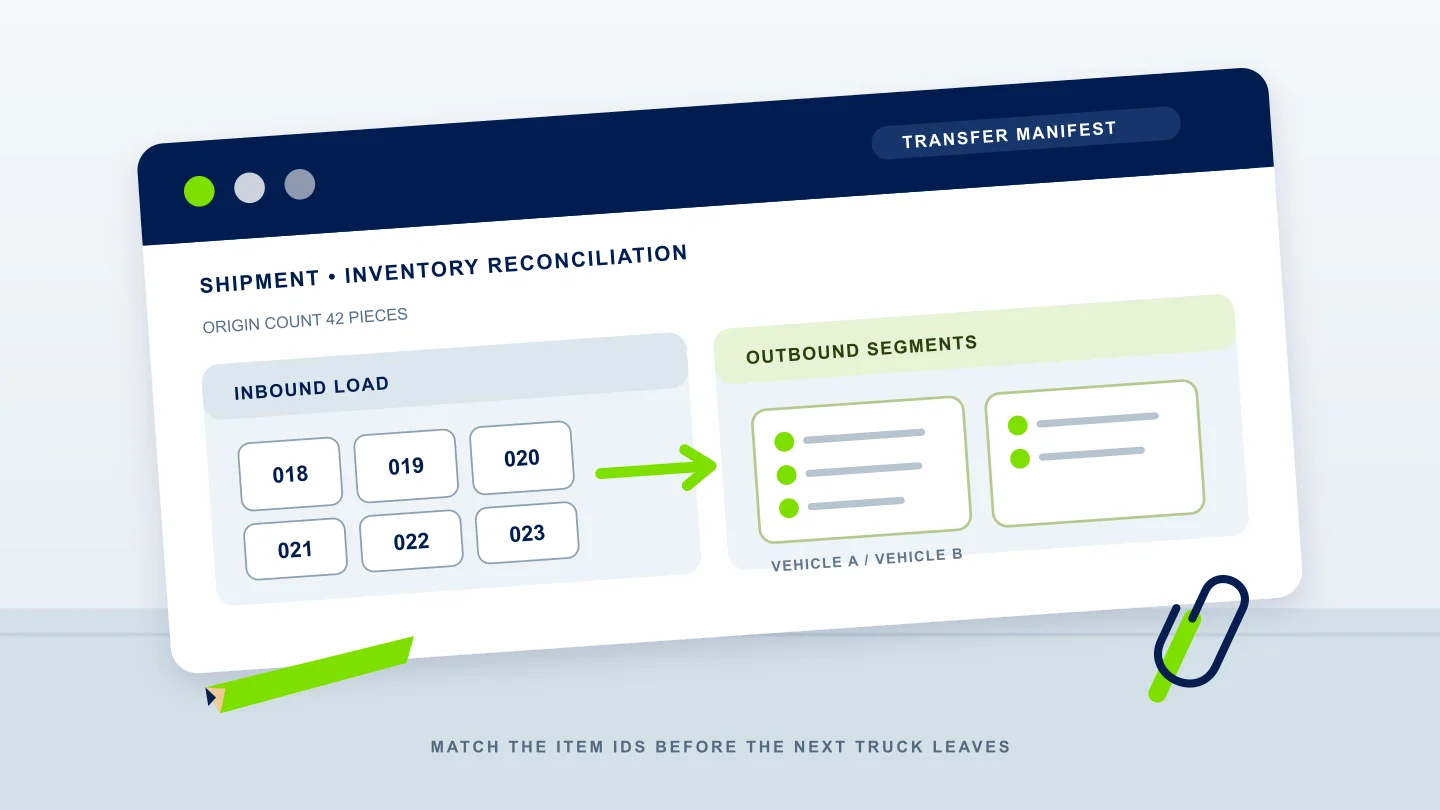
Before pickup is complete, obtain the full descriptive inventory. The Federal Motor Carrier Safety Administration's pickup guidance says an interstate household-goods mover must prepare an inventory before or at loading, listing each item and its condition. You should review, sign each page with the driver, note disagreements, and keep a copy. The agency's safety planner explains that each carton and uncartoned item should be identified and have a corresponding identification number.
Count inventory entries rather than guessing from the number of rooms. Verify that cartons, furniture, rugs, bicycles, crates, and separate components all appear. If a sofa is wrapped in two pieces or a glass top travels in a crate, make sure the paperwork tells you how many physical pieces the carrier will handle. The count at origin becomes the reference for later transfers. If it is wrong, every later reconciliation starts with a false total.
Take a clear photo of unusual items and their inventory tags, but do not photograph every ordinary carton simply to create hundreds of files you cannot use. Keep a short list of high-priority identifiers: a mirror crate, a piano bench, a detached table leaf, a bicycle, and any item whose shape makes it easy to set aside on the dock. If the carrier records a seal or container number, save it. Do not assume all shipments are sealed; ask which identifiers the company actually uses.
Find out whether the shipment is intact, consolidated, or split
Ask the coordinator whether the load is expected to transfer at a terminal and whether any part will ride on a separate vehicle. The answer may change while the shipment is underway, so ask again when a route update occurs. FMCSA notes that a household shipment sometimes must be divided among two or more trucks. If it is split, one overall origin count is no longer enough to know what each truck carries. Request a division list or at least an item-number range or container reference for each segment.
A carrier may use a consolidated line-haul trailer that serves multiple households. In that case, a terminal tally must distinguish your shipment from the neighboring shipment. Color-coded tags, shipment numbers, or container IDs can help, but only when used consistently. Ask how the carrier prevents a piece from being assigned to the wrong destination. A status page saying “in transit” cannot answer that.
The difference between a transfer and a split is important. A transfer can move all pieces from one truck to another. A split intentionally sends portions on separate trucks, possibly with different arrival days. If the carrier says the load is split, ask for each truck's reference, expected arrival window, and which pieces or vaults it contains. Do not treat the first partial delivery as final without checking the documented remainder.
Use a four-number transfer check
For each handoff, the carrier should be able to explain four figures: pieces expected, pieces physically unloaded, pieces assigned to the outgoing vehicle, and pieces left at the facility. Those figures should reconcile. If 76 pieces were expected, 76 arrived, 72 left on the next truck, and four remained for a second truck, the location of the four should be known and documented. If only 74 arrived, the discrepancy began before the terminal. If 76 arrived but 74 left with no planned remainder, the terminal transfer itself needs investigation.
Do not reduce the check to a single total. Two wrong items can offset each other numerically. Where practical, ask the carrier to reconcile numbered tags or container IDs. A vault-level transfer record should be tied to the item-level origin inventory. If it cannot be, record what level of detail is available and ask how a missing item would be traced. The point is not to demand an impossible photograph of every handoff; it is to understand the company's actual control process.
A useful transfer note includes date and time, facility name and physical location, sending vehicle or trip number, receiving vehicle or trip number, counts, exception list, and names or roles of the people who signed. If the carrier will not share an internal form, ask for a written customer-facing confirmation with the count and any exceptions. Keep the origin inventory nearby so you can ask about a specific numbered article.
Verify the exceptions, not only the totals
A terminal may note a damaged carton, a loosened wrap, a missing label, or a piece that was set aside for special handling. Ask for the exception record and what action followed. Was the carton rewrapped? Was a new tag applied, and how does it map to the old number? Did a fragile crate stay in a secure area for a different truck? If the carrier cannot answer, a later claim may become a debate over when the problem appeared.
Do not accept a generic “all good” if the inventory or transfer report shows a specific exception. Conversely, do not interpret every rewrap as damage to contents. Ask whether the outer package or the article itself was affected and whether photos were taken. Keep the original tag number in any relabeling record. When a label falls off, the descriptive inventory, item photo, and dimensions can help identify the correct shipment.
If a piece appears to be missing, ask the carrier to search the inbound vehicle, dock, staging area, overflow rack, and adjacent assigned load before the outgoing truck departs if operationally possible. Give the exact inventory number and description. Ask for a case reference and a written update. A vague message about “one box” wastes the narrow window in which the physical search is easiest.
Pay special attention to loose and awkward items
Small parts and unusual shapes are vulnerable at transfers. A lamp shade, rug roll, bike wheel, table leaf, piano bench, or hardware bag may not stack with regular cartons. Ask the origin crew how such items were packed and labeled. If a part was bundled to the main object, record that relationship. If the carrier later separates it for safety, the transfer record should show the new piece count and where each component goes.
For valuable or delicate items, photograph the exterior packaging and tag before pickup. Ask whether the carrier has a specific handling notation. Do not assume a handwritten “fragile” label replaces proper packing or tracking. If a third-party specialist handles an object outside the household shipment, keep its paperwork separate. Its piece count should not be added to the mover's inventory unless the same carrier actually accepted it under that bill of lading.
A vehicle transported by an auto carrier is an example: it has its own condition inspection and delivery record. A car listed on the household inventory can also change how a summary count is calculated; FMCSA's pickup guidance notes a special count treatment for an automobile on an inventory. Ask the carrier to explain the count it uses rather than forcing every item into a generic “box total.”
Ask who owns the next communication
A transfer can interrupt the familiar driver relationship. At origin you may have spoken to one driver; after terminal handling, another crew or agent may take over. Ask for the name and contact channel of the person responsible for the shipment from the transfer onward. Keep the main carrier's customer-service route as well. You should not have to call multiple terminals without knowing which one currently has custody.
Request a revised ETA if the transfer changes the route. A shipment may show a terminal arrival date but not yet have a confirmed outgoing departure. Ask for both events separately. “Arrived in destination city” does not mean it is loaded for final delivery. If the goods are awaiting a smaller vehicle or warehouse space, that is a distinct status with its own contact and appointment consequences.
Write down what you were told, by whom, and when. Confirm important changes by email or through the carrier's portal. If the company uses a tracking number per segment, save every number and cross-reference them to the original bill of lading. A clear communication chain helps you get a count from the right facility rather than receiving a generic update from someone who cannot see the transfer record.
A worked example with a planned split
A household has 92 numbered items loaded in Denver for delivery in Massachusetts. At a regional terminal, the carrier plans to move 88 items onto one outbound truck and four oversized pieces onto a second vehicle that can handle the destination street. The transfer record shows 92 pieces unloaded, 88 assigned to truck A, and four assigned to truck B, with the inventory numbers for the four listed. This is a planned split rather than a shortage.
The customer receives an updated schedule for both segments. When truck A arrives, the receiver checks the 88 expected pieces, notes one torn carton, and does not sign a statement that all 92 have been delivered. Two days later, truck B brings the four oversized pieces. The customer compares their tags with the division list and records final condition. If one of the four does not arrive, the carrier can search a specific terminal area and vehicle rather than reconstructing the entire cross-country move.
Change one fact: the terminal shows only 91 items unloaded, with no planned exclusion. The customer asks the carrier to identify the missing inventory number before the outgoing trucks depart. Even if the item is later found, this early discrepancy tells everyone where to start. A count is valuable because it narrows the search while the evidence and people are still available.
Reconcile at destination without rushing
Before the delivery appointment, ask which segment or truck is arriving and how many pieces it is expected to carry. If the shipment was split, have a separate list for each. At delivery, check off items as they enter the home and note missing or visibly damaged pieces on the inventory or delivery record before signing, as FMCSA's moving checklist recommends. Do not count empty blankets, dollies, or reusable equipment as shipment pieces. Keep the driver's tally and your own tally distinct until they agree.
If a carton is relabeled or repacked, ask the crew to show the link to its original number. If the crew says a missing item is on a later truck, request the later truck reference and date. Avoid a vague assurance that it is “probably at the warehouse.” An explicit remainder list makes the subsequent appointment and claim process manageable.
When the final piece arrives, keep the transfer records with the bill of lading and signed inventory. A later damage claim may depend on whether the condition was noted at a terminal, at final delivery, or only after unpacking. Preserve photographs and any exception reports in chronological order. Do not alter original forms; add a separate dated explanation if a record needs context.
Build an escalation request that can be answered
If the carrier cannot reconcile the count, send a concise request: shipment number, origin inventory total, last confirmed count, disputed item numbers, terminal and transfer date, outgoing vehicle reference, and the specific record you want. Ask who is leading the search and when you will receive an update. This is more actionable than repeated calls asking where the shipment is. It also creates a written history if a formal claim becomes necessary.
For the next handoff, our guide to coordinating dispatch updates during a route interruption explains how to track an ETA that changes after terminal arrival. If the terminal has completed the line haul and you are waiting for the local crew, book a final-mile delivery appointment after line haul before assuming the goods will come straight to the residence. A good transfer count does more than detect loss. It tells the final-mile team exactly what it is responsible for bringing.
Make a simple transfer worksheet
Even if the carrier never gives you its internal dock sheet, make your own worksheet with one row per known transfer. Use these headings: facility, arrival date, inbound vehicle, pieces expected, pieces received, exceptions, outbound vehicle, pieces loaded, pieces retained, and next contact. Leave cells blank until the carrier supplies a number. Write “not confirmed” rather than zero when a count is missing. Zero is a claim that no goods are present; an unknown count is a request for evidence.
For a split shipment, add separate rows for each outgoing vehicle and a column for the inventory numbers assigned to it. A total of 92 pieces can reconcile across two trucks only if the two lists do not duplicate or omit an item. Ask whether a loose or oversized piece was counted as part of a wrapped bundle at origin but counted separately at transfer. A change in counting unit should be explained in a notation, not silently treated as a shortage or overage.
Share a short version of the worksheet with the destination receiver. If you cannot attend delivery, that person needs to know whether the truck is expected to bring a complete shipment, a partial segment, or only a special item. Provide the relevant inventory pages and a phone number for the carrier. Ask the receiver to photograph any exception and send the signed delivery page to you the same day. A later claim becomes much harder when the only person who saw the unloading has no copy of what was signed.
If a terminal is closed to customers, do not attempt to visit without permission. Ask the carrier's coordinator for the count and documentation through its normal channel. The operational team may be able to check tags, dock camera records, or staging areas more effectively than a customer at the gate. Your role is to keep the identifiers accurate, ask for a timely reconciliation, and preserve the response. If the carrier gives inconsistent numbers on successive calls, send a written summary of both figures and ask which count is verified and what caused the change.
Check the current rule, contract and source page for your route and service. This guide helps you prepare clear questions and records.