
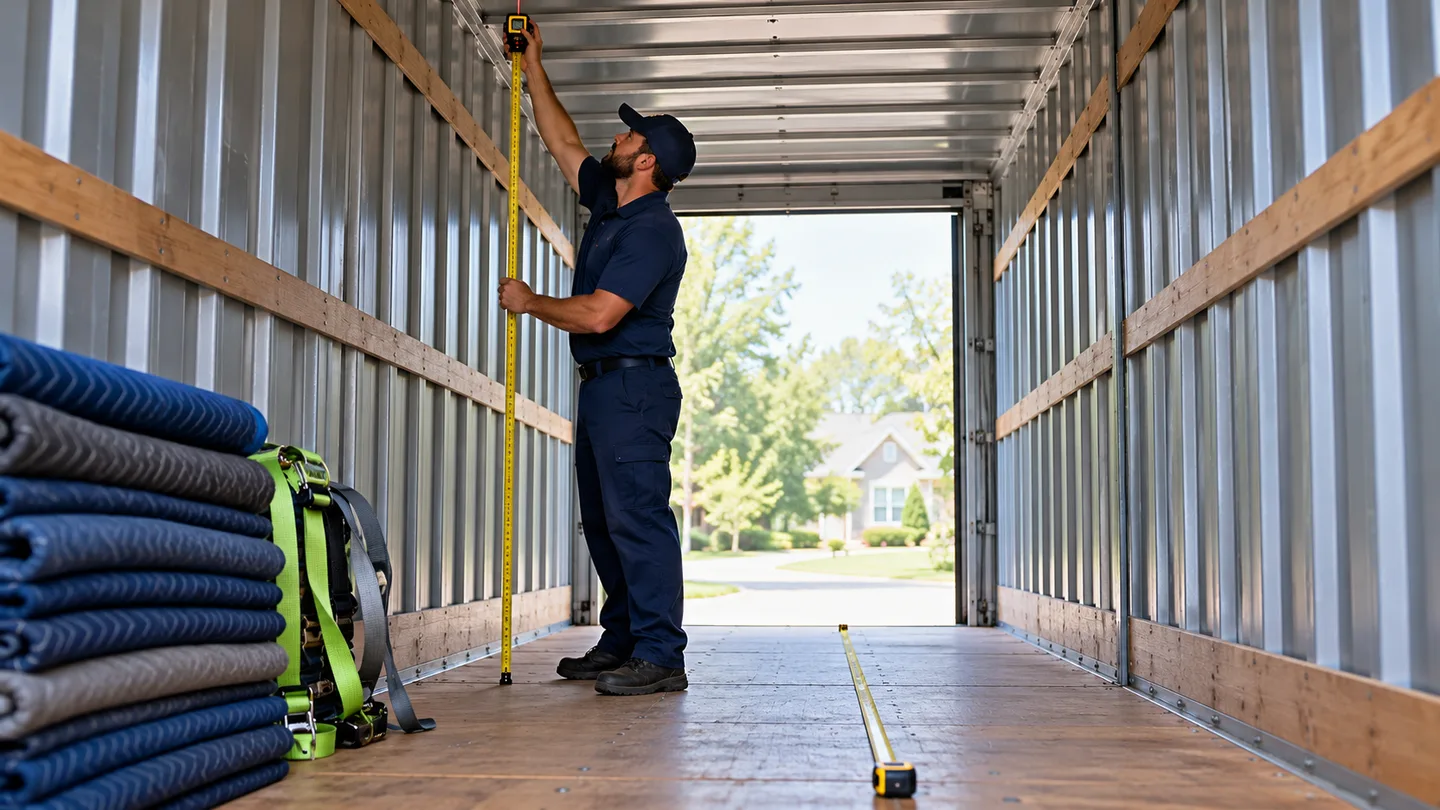
A container's advertised length is a starting point, not a promise that every cubic foot can hold household goods. Doors need clearance to close. Fragile pieces need protection. Heavy objects need a stable base. Some furniture cannot be stacked, and a tall cabinet that theoretically fits the ceiling may not pass through the opening or turn inside. A useful space estimate therefore begins with a measured inventory and ends with a load plan that the actual equipment can carry safely.
This matters because a shortage discovered after delivery can be expensive. A second container, an overflow shipment, extra storage days, or a delayed pickup can change both the price and the handoff schedule. The opposite error also matters: reserving much more equipment than the shipment needs can waste money or space at the property. There is no universal “three-bedroom home equals one container” rule. Household density, furniture shapes, disassembly choices, and the provider's particular unit all affect the result.
The PODS container-size page illustrates why exterior labels should not be mistaken for interior loading dimensions or weight capacity. Its published 8-, 12-, and 16-foot options have different weight limits, and the company notes that models can vary. U-Pack's FAQ explains another pricing model: a customer-loaded trailer can be billed by the linear feet of floor length used, with the full trailer width and height available within that length. Check the current specifications and terms for the provider and unit you will actually receive.
Begin with an inventory that describes shapes

Walk every room, closet, garage, attic, and outdoor storage area. List each large object separately: sofa, sectional pieces, mattress, bed frame, dining table, bookcase, dresser, refrigerator, exercise machine, bicycle, and lawn equipment. Count boxes by approximate size only after deciding what will really be packed. Label items that will be sold, donated, discarded, shipped separately, or carried personally. A space estimate based on everything visible today will be misleading if half the items will not go; an estimate based only on furniture will fail when hundreds of boxes appear later.
For each large piece, record its widest, deepest, and tallest dimensions in the orientation in which it can safely travel. A couch that measures seven feet along the wall may have a protruding arm or fixed chaise. A table may be shorter after legs are removed, but only if the hardware can be removed without damage and kept with the piece. Note glass, stone, electronics, liquids, and items the provider prohibits. Do not assume an appliance can be laid on its side or stacked under a heavy item. Follow the manufacturer's handling guidance and the provider's written restrictions.
Record weight concerns as well as volume. A container can look only half full yet reach its permitted load if it holds dense books, tools, or equipment. PODS lists different maximum contents weights for different sizes; that example is a reminder to obtain the actual unit's weight limit, not a number to apply to another company. Ask whether the limit includes packing materials and whether the provider uses a scale, an estimated load, or a customer declaration. If heavy items make the estimate uncertain, ask the provider how to verify compliance before pickup.
Photograph the inventory in groups, with a measure or known object for scale, and keep the list editable. Measurements need not be perfect to be useful, but large omissions can make a detailed spreadsheet falsely precise. A storage room of miscellaneous bins may deserve its own line item. If another household member adds a desk or removes a bed, update the plan before the equipment size is locked in.
Separate nominal volume from usable volume
A rectangular calculation—interior length times width times height—gives a geometric maximum. Real household goods leave irregular gaps. The door opening may be smaller than the interior height. Tie-down rails, wheel-well shapes, or structural parts may affect the loadable profile. Protective blankets and cartons take space. The final wall near the doors must be secured so it does not fall outward when opened. Ask for the unit's current inside dimensions, clear door opening, and usable floor length, then treat the calculated volume as an upper bound rather than a booking recommendation.
Sketch the floor as a grid. Put the longest and least flexible pieces on the plan first. A king mattress may be easier to stand on an edge if the provider allows that orientation and it is well protected; a stone tabletop may require a specialized crate or upright support. Do not draw fragile pieces underneath dense boxes merely to make the diagram fit. Place heavy, stable items low and distribute weight in line with the provider's instructions. The exact securing method belongs in the customer-loaded trailer stability plan, but the space estimate should reserve room for protection and restraint.
A simple example exposes the limit of cubic-foot arithmetic. Suppose a unit's interior is roughly fifteen feet long, seven feet wide, and seven feet high. Multiplying those figures gives 735 cubic feet. That number says nothing about whether two long sofas, a dining table, and a stack of mattresses can be arranged with a usable loading sequence. It also says nothing about a door frame narrower than a tall armoire. Use the geometry to reject impossible plans, then use an item-by-item layout to judge a plausible one. These figures are an illustration, not a published specification for a particular container.
Leave a deliberate allowance for uncertain items rather than silently assuming perfect packing. Some items will be larger once wrapped. A disassembled bed may create awkward rails and hardware boxes. A chair with curved arms may not nest against a square cabinet. The allowance is a planning buffer, not a license to exceed weight or stack unsafely. If the margin depends on standing a refrigerator under a precarious pile, the plan has already failed.
Check the doorway and loading path
Measure the actual doorway of the reserved unit if possible, or request its clear opening dimensions. An item may fit inside the empty box but fail at the threshold. The person carrying it needs room to rotate and set it down. Check ramps, ground clearance, and any lip at the entrance. Then measure the route from the home: hallways, stair landings, elevator doors, gates, and tight corners. The container does not solve a furniture-access problem inside the building.
Work through the largest piece physically. Can it leave the room? Must the door be removed? Will it turn on the landing? Can it cross the ramp without tipping? Is there enough space inside the container for two people to reposition it? Ask professional labor for a site survey when an item is unusually large or valuable. Do not cut, bend, or force a piece based on a diagram. If it cannot be loaded safely, decide on disassembly, specialist transport, or leaving it behind before delivery day.
Check the loading sequence against the door. A carefully arranged back wall may block access to the next heavy item if it must be loaded later. Group goods by weight, size, and the order in which they should enter. Keep the tools, straps, blankets, and assembly parts accessible while they are needed. The last wall must be both full enough to keep goods from shifting and restrained enough to let the doors open at destination. Reserving a few inches at the wrong end is not equivalent to designing the final door area.
Compare one unit with two and with a trailer
If the inventory exceeds one unit, ask for written pricing for a larger unit, two smaller units, and a customer-loaded trailer where available. Compare the full transport chain, not only rental price. Two units may mean two delivery slots, two locks, separate numbers to track, additional placement space, and separate final delivery or empty-unit pickup appointments. One larger unit may fail a driveway or weight constraint. A trailer may offer more length but require a suitable parking area and a raised loading deck. Each option changes the work the household must do.
U-Pack's space estimator provides an example of estimating trailer linear feet or container count from a household inventory. It is a provider-specific starting point. Its FAQ states that trailer pricing is based on occupied linear footage, while its ReloCube pricing is based on the number of cubes used. That does not mean a household can reserve any fraction of a cube or disregard minimum charges. Ask how the provider measures and rounds occupied space, whether the divider's position determines the billed length, and when the final charge is set.
Compare uncertainty too. If an estimate sits at the capacity boundary, what happens when the load does not fit? Can a second unit be dispatched in time, and at what cost? Can the household choose to leave items behind? Will the provider transport an overflow shipment under the same schedule? A quote that covers exactly the estimated volume with no workable overflow plan may be riskier than a slightly more expensive option with spare capacity. The right margin depends on deadline, access, item value, and available labor.
Weight can reverse a volume-based choice. Splitting heavy books and tools between two units may be more appropriate than loading one large unit to the roof. Conversely, two lightly loaded units need separate securement; empty air is not automatically safer. Ask the provider how it expects weight to be distributed and whether it can inspect a customer-loaded unit before pickup. Never infer transport safety from a neat-looking photograph alone.
Build a trial load on paper
Make a room-by-room list and assign every large item to a zone of the proposed unit: back wall, left side, right side, center, or door wall. Mark which items can be vertical, which must stay level, and which cannot bear a load. Identify boxes that fill gaps without pushing against fragile surfaces. Treat straps, pads, and the container's own anchoring points as constraints. The plan should show a plausible sequence from the first heavy piece to the last box, not just a final image with objects somehow interlocked.
Use a second pass to count cartons. Small boxes can fit in strong, level stacks if contents and cartons permit; a pile of mixed cartons is less predictable. Do not count the empty space under a table as fully usable until you know whether its legs remain attached and whether boxes can be secured there. Cushions and soft items may fill irregular spaces, but they should not be compressed into a position that opens a cabinet door or blocks the container door. Keep hazardous or prohibited goods out of the calculation entirely.
Give the plan to the people who will load. If hired laborers arrive with a different strategy, discuss the limits before heavy goods go in. Their experience can improve the arrangement, but a change must still respect the provider's weight, securing, and door-clearance requirements. Assign one person to keep the inventory updated as items enter; this helps locate an object later and reveals omissions before the final wall is built. A photograph at each loading stage can show how space was actually used.
Do not treat a perfect digital packing visualization as proof. Algorithms may rotate or stack objects in ways a person cannot safely execute, and generic box dimensions omit padding. If using a planner app, keep it subordinate to the actual interior measurements and the loader's judgment. The estimate should be understandable without a proprietary file: a measured list, a simple sketch, and written assumptions are enough for a provider to review.
Recognize when the estimate has changed
A capacity estimate is valid only for the inventory used to make it. Revisit it after decluttering, after a packing company reports carton counts, and whenever a new large item is added. Also revisit it when the provider substitutes a unit model. Ask whether the interior dimensions, door opening, weight limit, and tie-down arrangement are the same. A nominally equal exterior size may still require a different load plan. Keep the changed specification with the booking record.
At delivery, inspect the empty unit before loading. Check its unit number, interior condition, floor, doors, and usable measurements. If the unit is damaged, wet, or materially different from what was promised, stop and contact the provider. Photograph the issue. Loading goods before documenting a problem makes it harder to distinguish pre-existing damage from transport damage. It can also commit the household to a unit that cannot safely carry the planned load.
If the trial layout fails on the ground, stop at a stable point rather than forcing the last objects into the doors. Ask whether the provider can supply another unit or a different transport arrangement. Document which items remain, which are already loaded, and whether the new plan affects price or schedule. Before sealing, photograph the condition of major pieces and the final load. The pre-seal condition record explains how to turn those photos and inventory notes into a useful handoff record.
Price the space you might actually use
When comparing quotes, write each price next to the capacity and measurement rule it buys. A fixed-price container may charge for the full unit even if only part is filled. A trailer may charge by occupied linear feet, subject to a minimum or rounding rule. A traditional full-service interstate mover may use a different estimate and charge structure. Do not compare a container's monthly rental line with a mover's transportation total as though they cover the same work. Include equipment delivery, line haul, storage, fuel or service charges, loading labor, permits, and final pickup where applicable.
Ask for a price at the expected load and at one realistic larger load. If your boxes grow by ten or fifteen percent, does the equipment still fit? For a linear-foot trailer, how does the price change if the divider moves one foot? For a container, would an additional unit trigger another transport charge and another delivery appointment? The answers reveal whether a small inventory error produces a small adjustment or a second shipment. Record the provider's written response rather than relying on a salesperson's rough example.
Be careful with “free space” behind a trailer divider. The divider marks the area the household has rented; goods must remain within it under the provider's loading rules. Likewise, do not use a container's door clearance as overflow room. A unit that only closes when a box is pushed against the doors may open dangerously later. If the shipment barely fits in a draft plan, choose a larger or differently structured option before loading begins. An honest estimate should leave the household with a safe fallback, not a last-minute gamble.
Use a decision rule, not a room-count slogan
Choose equipment only after four questions have answers. First, can every intended item travel under the provider's restrictions? Second, do the actual interior and door dimensions support a safe loading sequence? Third, is the estimated weight within the unit's limit with a reasonable margin? Fourth, can the equipment be placed, loaded, picked up, and delivered at both addresses under the property's rules? A “yes” to cubic volume alone does not settle the shipment.
Write down the assumptions that drive the decision: item list, disassembly plan, unit model, dimensions, weight concerns, protective materials, overflow option, and price consequence of additional space. Ask the provider to confirm any specification on which the plan depends. The resulting estimate is not a guarantee that a moving day will go exactly to plan. It is a defensible way to see a shortage early enough to change the equipment or the inventory before the first box enters the container.
Check the current rule, contract and source page for your route and service. This guide helps you prepare clear questions and records.